
|
You entered: interstellar dust
 Interstellar Comet 2I Borisov
14.12.2019
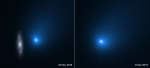
From somewhere else in the Milky Way galaxy, Comet 2I/Borisov is just visiting the Solar System. Discovered by Crimean amateur astronomer Gennady Borisov on August 30, 2019, the first known interstellar comet is captured in these two recent Hubble Space Telescope images.
 M64: The Black Eye Galaxy
20.07.2023
This magnificent spiral galaxy is Messier 64, often called the Black Eye Galaxy or the Sleeping Beauty Galaxy for its dark-lidded appearance in telescopic views. The spiral's central region, about 7,400 light-years across, is pictured in this reprocessed image from the Hubble Space Telescope.
 APOD: 2025 July 17 Б 3I/ATLAS
17.07.2025
Discovered on July 1 with the NASA-funded ATLAS (Asteroid Terrestrial-impact Last Alert, System) survey telescope in Rio Hurtado, Chile, 3I/ATLAS is so designated as the third known interstellar object to pass through our Solar System It follows 1I/йOumuamua in 2017 and the comet 2I/Borisov in 2019.
 A Particle Beam Jet forms HH 24
4.02.2014
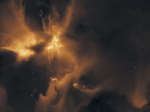
If you visit HH 24, don't go near the particle beam jet. This potential future travel advisory might be issued because the powerful jet likely contains electrons and protons moving hundreds of kilometers per second.
 Herbig Haro 24
18.12.2015
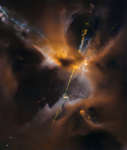
This might look like a double-bladed lightsaber, but these two cosmic jets actually beam outward from a newborn star in a galaxy near you. Constructed from Hubble Space Telescope image data, the stunning scene...
 Herbig Haro 24
28.05.2025
This might look like a double-bladed lightsaber, but these two cosmic jets actually beam outward from a newborn star in a galaxy near you. Constructed from Hubble Space Telescope image data, the stunning scene...
 Duel Particle Beams in Herbig Haro 24
11.03.2018
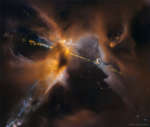
This might look like a double-bladed lightsaber, but these two cosmic jets actually beam outward from a newborn star in a galaxy near you. Constructed from Hubble Space Telescope image data, the stunning scene...
 Interstellar Comet 2I Borisov
5.03.2022
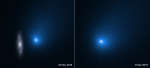
From somewhere else in the Milky Way galaxy, Comet 2I/Borisov was just visiting the Solar System. Discovered by amateur astronomer Gennady Borisov on August 30, 2019, the first known interstellar comet is seen in these two Hubble Space Telescope images from November and December 2019.
 The Dark River to Antares
16.05.2020
A dark river seems to flow through this sky from the horizon toward colorful clouds near red giant star Antares. Murky looking, the dark river is a dusty nebula obscuring background starlight near the central Milky Way, although the dark dust nebula contains mostly hydrogen molecular gas.
 Our Galaxys Magnetic Field from Planck
26.01.2015
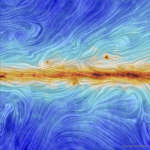
What does the magnetic field of our Galaxy look like? It has long been known that a modest magnetic field pervades our Milky Way Galaxy because it is seen to align small dust grains that scatter background light. Only recently, however, has the Earth-orbiting Planck satellite made a high-resolution map of this field.
|
January February March April May June July August September |
|||||||||||||||||||||||||||||||||||||||||||||||||