
|
You entered: night sky
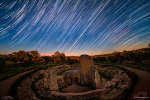 Star Trails and the Equinox Sunrise
21.03.2019
Stars trail and the Sun rises in this night and day composite panorama made on March 19. The view looks toward the eastern horizon from La Nava de Santiago, Spain. To create...
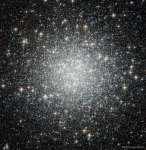 Blue Straggler Stars in Globular Cluster M53
7.02.2021
If our Sun were part of this star cluster, the night sky would glow like a jewel box of bright stars. This cluster, known as M53 and cataloged as NGC 5024, is one of about 250 globular clusters that survive in our Galaxy.
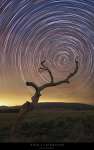 APOD: 2026 April 16 Б South Celestial Tree
16.04.2026
If you live in the northern hemisphere, you may have learned how to locate the North Star, Polaris, in the night sky. It can be used to find north, and it approximately marks the northern celestial pole.
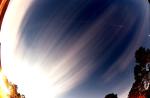 International Space Station Trail
14.12.2000
Still under construction, the International Space Station is literally becoming one of the brightest, fastest moving stars in the heavens. Despite illuminated clouds and bright light from a nearly full moon (lower left), this...
 At The Core Of M15
17.01.1998
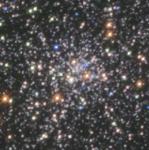
Densely packed stars in the core of the globular cluster M15 are shown in this Hubble Space Telescope (HST) image. The star colors roughly indicate their temperatures - hot stars appear blue, cooler stars look reddish-orange.
 Bright Lights, Dark City
18.08.2003
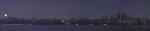
Last Thursday, millions of people had an unexpectedly good view of a dark night sky. Usually, the reflection of city lights off of local air impurities makes it hard for casual observers to see more than a handful of stars from a bright urban area.
 Alpha Centauri: The Closest Star System
3.07.2011
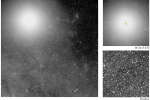
The closest star system to the Sun is the Alpha Centauri system. Of the three stars in the system, the dimmest -- called Proxima Centauri -- is actually the nearest star. The bright stars Alpha Centauri...
 Horsehead and Orion Nebulae
10.03.2009
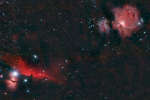
Adrift 1,500 light-years away in one of the night sky's most recognizable constellations, the glowing Orion Nebula and the dark Horsehead Nebula are contrasting cosmic vistas. They appear in opposite corners of this stunning mosaic taken with a digital camera attached to a small telescope.
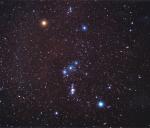 Orion on Film
7.02.2003
Orion, the Hunter, is one of the most easily recognizable constellations in planet Earth's night sky. But Orion's stars and nebulae don't look quite as colorful to the eye as they do in this lovely photograph, taken last month from Vekol Ranch south of Phoenix, Arizona, USA.
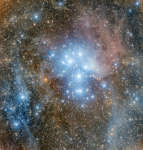 Messier 45: The Daughters of Atlas and Pleione
7.11.2019
Hurtling through a cosmic dust cloud a mere 400 light-years away, the lovely Pleiades or Seven Sisters open star cluster is well-known for its striking blue reflection nebulae. It lies in the night sky toward the constellation Taurus and the Orion Arm of our Milky Way Galaxy.
|
January February March April May June July August September October |
|||||||||||||||||||||||||||||||||||||||||||||||||