
|
You entered: ring
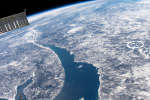 APOD: 2025 October 11 Б Manicouagan Impact Crater from Space
11.10.2025
Orbiting 400 kilometers above Quebec, Canada, planet Earth, the International Space Station Expedition 59 crew captured this snapshot of the broad St. Lawrence River and curiously circular Lake Manicouagan on April 11, 2019. Right of center, the ring-shaped lake is a modern reservoir within the eroded remnant of an ancient 100 kilometer diameter impact crater.
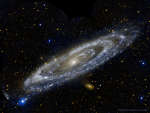 The Andromeda Galaxy in Ultraviolet
18.07.2021
What does the Andromeda galaxy look like in ultraviolet light? Young blue stars circling the galactic center dominate. A mere 2.5 million light-years away, the Andromeda Galaxy, also known as M31, really is just next door as large galaxies go.
 Starburst Galaxy Messier 94
6.03.2025
Beautiful island universe Messier 94 lies a mere 15 million light-years distant in the northern constellation of the hunting dogs, Canes Venatici. A popular target for earth-based astronomers, the face-on spiral galaxy is about 30,000 light-years across, with spiral arms sweeping through the outskirts of its broad disk.
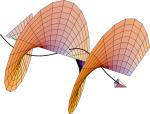 Light Can Twist as Well as Spin
19.11.2003
Light is more complicated than we thought. When astronomers measure light, they are usually concerned with its direction, energy, and spin polarization (sometimes). Recently, however, it has been more broadly realized that photons...
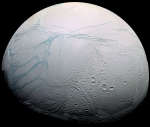 Fresh Tiger Stripes on Saturn's Enceladus
28.06.2009
Do underground oceans vent through the tiger stripes on Saturn's moon Enceladus? Long features dubbed tiger stripes are known to be spewing ice from the moon's icy interior into space, creating a cloud of fine ice particles over the moon's South Pole and creating Saturn's mysterious E-ring.
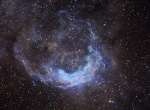 Windblown NGC 3199
22.05.2008
NGC 3199 lies about 12,000 light-years away, a glowing cosmic cloud in the southern constellation of Carina. The nebula is about 75 light-years across in this haunting, false-color view. Though the deep image...
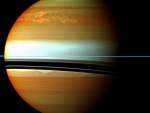 A Raging Storm System on Saturn
28.04.2013
It was one of the largest and longest lived storms ever recorded in our Solar System. First seen in late 2010, the above cloud formation in the northern hemisphere of Saturn started larger than the Earth and soon spread completely around the planet.
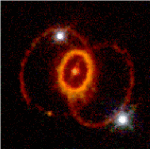 Supernova 1987a Aftermath
21.06.1995
In 1987 a star in one of the Milky Way's satellite galaxies exploded. In 1994 the Hubble Space Telescope, in orbit around the earth, took a very detailed picture of the remnants of this explosion. This picture, above, showed unusual and unexpected rings, and astronomers are not sure how they formed.
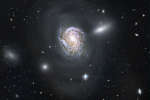 NGC 4911: Spiral Diving into a Dense Cluster
8.09.2010
Why are there faint rings around this spiral galaxy? Possibly because the galaxy, NGC 4911, is being pulled at by its neighbors as it falls into the enormous Coma Cluster of Galaxies.
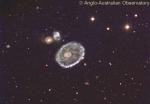 The Cartwheel Galaxy
12.06.2001
By chance, a collision of two galaxies has created a surprisingly recognizable shape on a cosmic scale. The Cartwheel Galaxy is part of a group of galaxies about 500 million light years away in the constellation Sculptor. Two smaller galaxies in the group are visible on the left of the above photograph.
|
January February March April May June July August September October |
|||||||||||||||||||||||||||||||||||||||||||||||||