
|
You entered: rocks
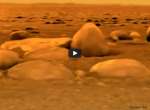 Huygens: Titan Descent Movie
21.01.2013
What would it look like to land on Saturn's moon Titan? The European Space Agency's Huygens probe set down on the Solar System's cloudiest moon in 2005, and a time-lapse video of its descent images was created.
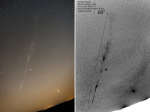 The Further Tail of Comet Leonard
29.12.2021
Comet Leonard, brightest comet of 2021, is at the lower left of these two panels captured on December 29 in dark Atacama desert skies. Heading for its perihelion on January 3 Comet Leonard's visible tail has grown.
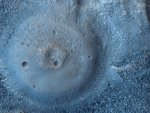 Possible Mud Volcanoes on Mars
30.03.2009
Is this a mud volcano on Mars? If so, could it be dredging up martian microbes? This strange possibility has been suggested recently and seems to fit several recent observations of Mars. First of all, hills like this seem to better resemble mud volcanoes on Earth than lava volcanoes and impact craters on Mars.
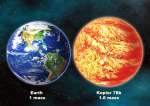 Kepler 78b: Earth Sized Planet Discovered
5.11.2013
Even though Kepler-78b is only slightly larger than the Earth, it should not exist. Its size is extraordinary only in the sense that it is the most similar in size to the Earth of any exoplanet yet directly discovered.
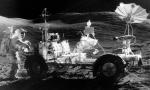 Apollo 17 s Lunar Rover
9.06.2001
In December of 1972, Apollo 17 astronauts Eugene Cernan and Harrison Schmitt spent about 75 hours exploring the Moon's Taurus-Littrow valley while colleague Ronald Evans orbited overhead. Cernan and Schmitt were the last humans to walk or ride on the Moon - aided in their explorations by a Lunar Roving Vehicle.
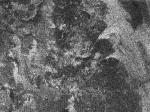 A Radar View of Titan
23.11.2004
Where are Titan's craters? Throughout our Solar System's five billion-year history, dangerous rocks and chunks of ice have continually slammed into planets and moons - usually creating numerous long lasting impact craters. When the robot spacecraft Cassini swooped past Saturn's moon Titan last month, however, radar images showed few craters.
 APOD: 2025 February 12 Б Asteroid Bennu Holds the Building Blocks of Life
11.02.2025
What can a space rock tell us about life on Earth? NASA's OSIRIS-REx spacecraft made a careful approach to the near-Earth asteroid 101955 Bennu in October of 2020 to collect surface samples. In September 2023, the robotic spaceship returned these samples to Earth.
 A Year of Assessing Astronomical Hazards
30.12.2002
Could an asteroid destroy civilization on Earth? Mountain-sized space rocks could potentially impact the Earth causing global effects, and perhaps even be mistaken for a nuclear blast of terrestrial origin. Such large impacts are rare but have happened before. Modern telescopes have therefore begun to scan the skies for signs of approaching celestial hazards.
 A Perseid Meteor
11.08.2004
The ongoing Perseid Meteor Shower should be at its strongest tonight and tomorrow night. Although meteors should be visible all night long, the best time to watch will be between 2:00 AM and dawn each night. In dark, moonless, predawn skies you may see dozens of meteors per hour.
 Everest Panorama from Mars
8.12.2013
If you could stand on Mars -- what might you see? Scroll right to find out. The robotic Spirit rover that rolled around Mars from 2004 to 2009 Mars climbed...
|
January February March April May June July August September |
|||||||||||||||||||||||||||||||||||||||||||||||||