
|
You entered: star formation
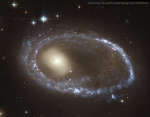 Ring Galaxy AM 0644 741 from Hubble
19.04.2015
How could a galaxy become shaped like a ring? The rim of the blue galaxy pictured on the right is an immense ring-like structure 150,000 light years in diameter composed of newly formed, extremely bright, massive stars.
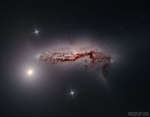 Galaxy Group Hickson 90
17.05.2017
Scanning the skies for galaxies, Canadian astronomer Paul Hickson and colleagues identified some 100 compact groups of galaxies, now appropriately called Hickson Compact Groups (HCGs). This sharp Hubble image shows one such galaxy group, HCG 90, in startling detail.
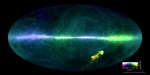 HI4PI: The Hydrogen Sky
24.10.2016
Where are the Milky Way's gas clouds and where are they going? To help answer this question, a new highest-resolution map of the sky in the universe's most abundant gas -- hydrogen -- has been completed and recently released, along with its underlying data.
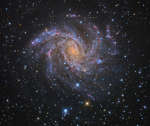 Fireworks Galaxy NGC 6946
1.01.2011
Celebrate the New Year with the Fireworks Galaxy! Also known as NGC 6946, the big, beautiful spiral galaxy is located just 10 million light-years away, behind a veil of foreground dust and stars in the high and far-off constellation of Cepheus. From our vantage point in the Milky Way Galaxy, we see NGC 6946 face-on.
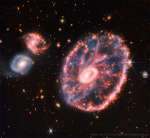 The Cartwheel Galaxy from Webb
24.08.2022
To some, it looks like a wheel of a cart. In fact, because of its outward appearance, the presence of a central galaxy, and its connection with what looks like the spokes of a wheel, the galaxy on the right is known as the Cartwheel Galaxy.
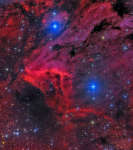 The Pelican Nebula in Red and Blue
1.03.2021
The Pelican Nebula is changing. The entire nebula, officially designated IC 5070, is divided from the larger North America Nebula by a molecular cloud filled with dark dust. The Pelican, however, is particularly interesting because it is an unusually active mix of star formation and evolving gas clouds.
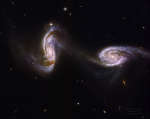 Arp 240: A Bridge between Spiral Galaxies from Hubble
28.11.2016
Why is there a bridge between these two spiral galaxies? Made of gas and stars, the bridge provides strong evidence that these two immense star systems have passed close to each other and experienced violent tides induced by mutual gravity.
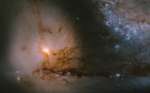 NGC 5195: The Dot under the Question Mark
31.08.2013
Dwarf galaxy NGC 5195 is best known as the smaller companion of spiral M51, the Whirlpool galaxy. Seen together they seem to trace the curve and dot of a cosmic question mark, recorded in Lord Rosse's 19th century drawings as one of the original spiral nebulae.
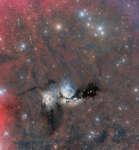 M78 Wide Field
21.01.2021
Interstellar dust clouds and glowing nebulae abound in the fertile constellation of Orion. One of the brightest, M78, is centered in this colorful, wide field view, covering an area north of Orion's belt. At a distance of about 1,500 light-years, the bluish reflection nebula is around 5 light-years across.
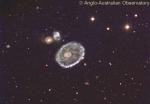 The Cartwheel Galaxy
12.06.2001
By chance, a collision of two galaxies has created a surprisingly recognizable shape on a cosmic scale. The Cartwheel Galaxy is part of a group of galaxies about 500 million light years away in the constellation Sculptor. Two smaller galaxies in the group are visible on the left of the above photograph.
|
January February March April May June July August September October |
|||||||||||||||||||||||||||||||||||||||||||||||||