
|
You entered: Earth orbit
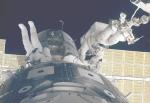 Assembling The International Space Station
10.12.1998
Batteries and solar panels were included with this version of the International Space Station (ISS) but some assembly is still required. On Saturday, December 5th, the STS-88 crew of the Space Shuttle Endeavor achieved the in orbit docking of the Zarya and Unity (foreground) ISS modules.
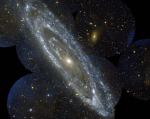 The Andromeda Galaxy from GALEX
22.12.2003
Why does the Andromeda Galaxy have a giant ring? Viewed in ultraviolet light, the closet major galaxy to our Milky Way Galaxy looks more like a ring galaxy than a spiral. The ring...
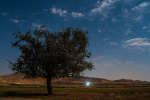 Perseid in Moonlight
15.08.2014
Bright moonlight from a Full Moon near perigee illuminates the night and casts shadows in this skyscape from central Iran. Taken on August 12, near the peak of the annual Perseid meteor shower the exposure also captures a bright and colorful perseid streak above the shady tree in the foreground.
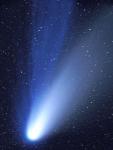 The Dust and Ion Tails of Comet Hale Bopp
27.12.2000
In 1977, Comet Hale-Bopp's intrinsic brightness exceeded any comet since 1811. Since it peaked on the other side of the Earth's orbit, however, the comet appeared only brighter than any comet in two decades. Visible above are the two tails shed by Comet Hale-Bopp.
 APOD: 2024 May 7 Б Black Hole Accreting with Jet
7.05.2024
What happens when a black hole devours a star? Many details remain unknown, but observations are providing new clues. In 2014, a powerful explosion was recorded by the ground-based robotic telescopes of the All Sky Automated Survey for SuperNovae (Project ASAS-SN), with followed-up observations by instruments including NASA's Earth-orbiting Swift satellite.
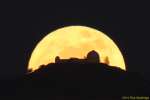 Apogee Full Moon
18.01.2014
This big, bright, beautiful Full Moon rose over Lick Observatory Wednesday night. Traditionally a full moon in January might be called the Wolf Moon. But this moon reached its full phase on January 16, 4:54 UT, within about 2 hours of apogee, the most distant point in its elliptical orbit around planet Earth.
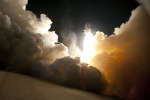 Night Launch of the Space Shuttle Endeavour
9.02.2010
Sometimes, the space shuttle launches at night. Pictured above, the space shuttle Endeavour lifted off in yesterday's early morning hours from Launch Pad 39A in Kennedy Space Center, Florida, USA, bound for the International Space Station (ISS).
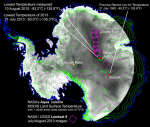 The Coldest Place on Earth
11.12.2013
How cold can it get on Earth? In the interior of the Antarctica, a record low temperature of -93.2 C (-135.8 F) has been recorded. This is about 25 C (45 F) colder than the coldest lows noted for any place humans live permanently.
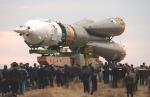 Rollout of Soyuz TMA 2 Aboard an R7 Rocket
9.10.2005
It takes a big rocket to go into space. In 2003 April, this huge Russian rocket was launched toward Earth-orbiting International Space Station (ISS), carrying two astronauts who will make up the new Expedition 7 crew.
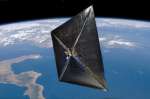 NanoSail D
28.01.2011
Featured in this artist's illustration, NASA's NanoSail-D finally unfurled a very thin, 10 square meter reflective sail on January 20th, becoming the first solar sail spacecraft in low Earth orbit. Often considered...
|
January February March April May June July August September October |
|||||||||||||||||||||||||||||||||||||||||||||||||