
|
You entered: camera
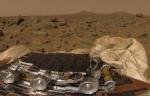 Pathfinder on Mars
5.07.1997
Yesterday, July 4th, using its own array of fireworks, a parachute, and a cocoon of airbags, the Mars Pathfinder spacecraft successfully bounced and came to rest on the surface of Mars at 10:07 AM Pacific Daylight Time.
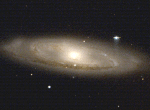 M65 Without Moth
7.08.1998
Messier 65 (M65) is a bright spiral galaxy of stars only 35 million light-years away in the constellation Leo. With very tightly wound spiral arms, a large central bulge, and well defined dust lanes, this galaxy is a member of a group of galaxies known as the Leo triplet.
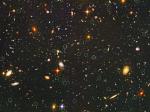 HUDF: Dawn of the Galaxies
29.09.2004
When did galaxies form? Faint red smudges identified on the deepest optical sky image ever taken may well be members of the first class of galaxies. Detailed inspection of the Hubble Ultra Deep Field...
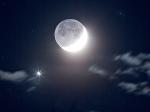 Venus Near the Moon
23.05.2007
The two brightest objects in the night sky appeared to go right past each other last week. On the night of May 19, Earth's Moon and the planet Venus were visible in the same part of the sky, and at closest approach were less than one degree apart.
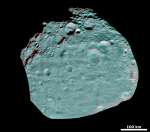 Stereo Vesta
20.08.2011
Get out your red/blue glasses and float next to 4 Vesta. A 500 kilometer diameter world, Vesta lies in the main asteroid belt between the orbits of Mars and Jupiter. This stereo anaglyph...
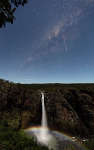 Meteor and Moonbow over Wallaman Falls
12.11.2012
Which feature takes your breath away first in this encompassing panorama of land and sky? The competition is strong with a waterfall, meteor, starfield, and even a moonbow all vying for attention. It is interesting to first note, though, what can't be seen -- a rising moon on the other side of the camera.
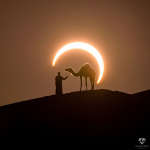 Solar Eclipse over the UAE
10.02.2020
What's happening behind that camel? A partial eclipse of the Sun. About six and a half weeks ago, the Moon passed completely in front of the Sun as seen from a narrow band on the Earth.
 APOD: 2023 August 21 Б Introducing Comet Nishimura
21.08.2023
Will Comet Nishimura become visible to the unaided eye? Given the unpredictability of comets, no one can say for sure, but it currently seems like a good bet. The comet was discovered only ten days ago by Hideo Nishimura during 30-second exposures with a standard digital camera.
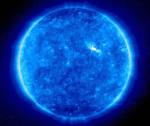 Blue Sun Glaring
6.01.1997
The Sun is a bubbling ball of extremely hot gas. In this false-color picture, light blue regions are extremely hot - over 1 million degrees, while dark blue regions are slightly cooler. The camera filter used was highly sensitive to the emission of highly charged iron ions, which trace the magnetic field of the Sun.
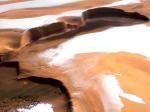 Steep Cliffs on Mars
15.03.2005
Vertical cliffs of nearly two kilometers occur near the North Pole of Mars. Also visible in the above image of the Martian North Polar Cap are red areas of rock and sand, white areas of ice, and dark areas of unknown composition but hypothesized to be volcanic ash.
|
January February March April May June July August |
||||||||||||||||||||||||||||||||||||||||||||||||||||||||