
|
You entered: horizon
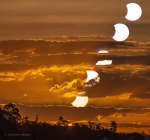 Brisbane Sunset Moonset
1.05.2014
In skies over Brisbane at the southeastern corner of Queensland, Australia, Planet Earth, the Sun and New Moon set together on April 29. There the celestial line-up, the first solar eclipse of 2014, was seen as a partial solar eclipse.
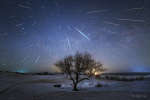 Gemini s Meteors
22.12.2017
From dark skies above Heilongjiang province in northeastern China, meteors rain down on a wintry landscape in this beautiful composited night scene. The 48 meteors are part of last week's annual Geminid meteor shower.
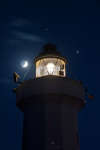 Great Conjunction over Sicilian Lighthouse
8.12.2020
DonБt miss the coming great conjunction. In just under two weeks, the two largest planets in our Solar System will angularly pass so close together in Earth's sky that the Moon would easily be able to cover them both simultaneously. This pending planetary passage -- on December 21 -- will be the closest since 1623.
 APOD: 2025 February 4 Б Anticrepuscular Rays: A Rainbow Fan over Spain
4.02.2025
Yes, but can your rainbow do this? Late in the day, the Sun set as usual toward the west. However, on this day, the more interesting display was 180 degrees around -- toward the east. There, not only was a rainbow visible, but an impressive display of anticrepuscular rays from the rainbow's center.
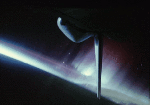 Aurora Astern
26.10.1995
Sailing upside down, 115 nautical miles above Earth, the crew of the Space Shuttle Endeavour made this spectacular time exposure of the southern aurora (aurora australis) in October of 1994. The aurora, also known...
 December Moon Meets Evening Star
9.12.2005
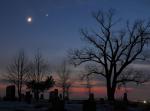
If you've been outdoors near sunset, then you've probably noticed Venus low in the west as the brilliant evening star. Sometimes mistaken for a tower light near the horizon, Venus is the third brightest celestial beacon, after the Sun and Moon, in planet Earth's sky.
 Aurora in the Distance
19.11.2007
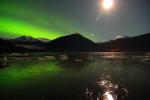
Some auroras can only be seen with a camera. They are called sub-visual and are too faint to be seen with the unaided eye. The reason is that the human eye only accumulates light for a fraction of a second at a time, while a camera shutter can be left open indefinitely.
 Anticrepuscular Rays Over Colorado
28.11.2010
What's happening over the horizon? Although the scene may appear somehow supernatural, nothing more unusual is occurring than a setting Sun and some well placed clouds. Pictured above are anticrepuscular rays. To understand them, start by picturing common crepuscular rays that are seen any time that sunlight pours though scattered clouds.
 Conjunction Over Reunion Island
7.03.2012
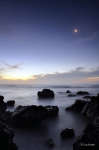
You don't have to be on Reunion Island to see this week's planetary conjunction. Only if you want to see this picturesque seascape as well. To see the conjunction from just about anywhere in the world, look to the west after sunset.
 The Terraced Night
6.02.2014
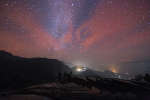
Long after sunset on January 25 an unusually intense red airglow floods this south-looking skyscape. The scene was recorded with a long exposure using a digital camera over Yunnan Province in southwest China. At best faintly visible to the eye, the lingering airglow is due to chemiluminescence, the production of light through chemical excitation.
|
January February March April May June July August September October |
|||||||||||||||||||||||||||||||||||||||||||||||||