
|
You entered: hot star
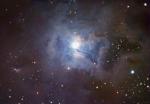 NGC 7023: The Iris Nebula
4.11.2004
Like delicate cosmic petals, these clouds of interstellar dust and gas have blossomed 1,300 light-years away in the fertile star fields of the constellation Cepheus. Sometimes called the Iris Nebula and dutifully cataloged as NGC 7023, this is not the only nebula in the sky to evoke the imagery of flowers.
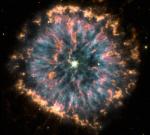 Celebrating Hubble With NGC 6751
7.04.2000
Planetary nebulae do look simple, round, and planet-like in small telescopes. But images from the orbiting Hubble Space Telescope have become well known for showing these fluorescent gas shrouds of dying Sun-like stars to possess a staggering variety of detailed symmetries and shapes.
 IC 59 and IC 63 in Cassiopeia
26.10.2018
These bright rims and flowing shapes look ghostly on a cosmic scale. A telescopic view toward the constellation Cassiopeia, the colorful (zoomable) skyscape features the swept-back, comet-shaped clouds IC 59 (left) and IC 63.
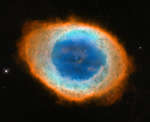 M57: The Ring Nebula
5.06.2013
Except for the rings of Saturn, the Ring Nebula (M57) is probably the most famous celestial band. Its classic appearance is understood to be due to our own perspective, though. The recent mapping...
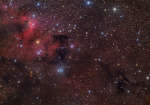 The Light, the Dark, and the Dusty
11.06.2015
This colorful skyscape spans about three full moons (1.5 degrees) across nebula rich starfields along the plane of our Milky Way Galaxy in the royal northern constellation Cepheus. Near the edge of the region...
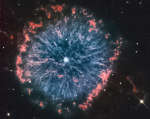 NGC 6751: The Glowing Eye Nebula
13.03.2013
Planetary nebulae can look simple, round, and planet-like in small telescopes. But images from the orbiting Hubble Space Telescope have become well known for showing these fluorescent gas shrouds of dying Sun-like stars to possess a staggering variety of detailed symmetries and shapes.
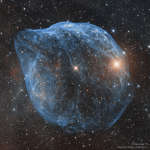 Sharpless 308: The Dolphin Nebula
2.03.2020
Blown by fast winds from a hot, massive star, this cosmic bubble is much larger than the dolphin it appears to be. Cataloged as Sharpless 2-308 it lies some 5,200 light-years away toward the constellation of the Big Dog (Canis Major) and covers slightly more of the sky than a Full Moon.
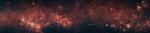 GLIMPSE the Milky Way
16.12.2005
Scroll right and gaze through the dusty plane of our Milky Way Galaxy in infrared light. The cosmic panorama is courtesy of the Galactic Legacy Infrared Mid-Plane Survey Extraordinaire (GLIMPSE) project and the Spitzer Space Telescope.
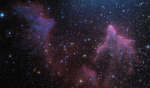 IC 59 and IC 63 in Cassiopeia
3.11.2011
These bright rims and flowing shapes suggest to some melting ice cream on a cosmic scale. Looking toward the constellation Cassiopeia, the colorful (zoomable) skyscape features the swept back, comet-shaped clouds IC 59 (left) and IC 63.
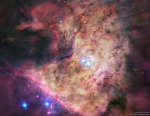 Trapezium: At the Heart of Orion
5.08.2018
Near the center of this sharp cosmic portrait, at the heart of the Orion Nebula, are four hot, massive stars known as the Trapezium. Gathered within a region about 1.5 light-years in radius, they dominate the core of the dense Orion Nebula Star Cluster.
|
January February March April May June July |
|||||||||||||||||||||||||||||||||||||||||||||||||