
|
You entered: stars
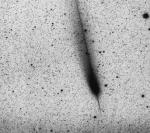 Hale Bopp: A Continuing Tail
19.02.1998
Where is Hale-Bopp now? The Great Comet of 1997, one of the largest and most active comets ever, is outbound about 400 million miles from the sun. Too faint for viewing without telescopes or binoculars, Hale-Bopp is presently positioned in the very southerly constellation of Pictor.
 A Giant Squid in the Flying Bat
26.10.2016
Very faint but also very large on planet Earth's sky, a giant Squid Nebula cataloged as Ou4, and Sh2-129 also known as the Flying Bat Nebula, are both caught in this cosmic scene toward the royal constellation Cepheus.
 APOD: 2024 December 30 Б M27: The Dumbbell Nebula
29.12.2024
Is this what will become of our Sun? Quite possibly. The first hint of our Sun's future was discovered inadvertently in 1764. At that time, Charles Messier was compiling a list of diffuse objects not to be confused with comets.
 APOD: 2025 November 23 Б The Observable Universe
22.11.2025
How far can you see? Everything you can see, and everything you could possibly see, right now, assuming your eyes could detect all types of radiations around you -- is the observable universe. In light...
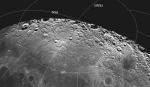 Help Map The Moon
11.09.1998
You can help map the Moon. Early tomorrow morning (Saturday, September 12) the Moon will occult, or pass in front of, the bright star Aldebaran as viewed from some Southern and Eastern areas of the U.S. as well as regions in the Caribbean Sea, Nova Scotia, Newfoundland, Mexico, and Central America.
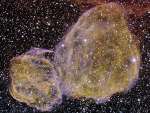 Double Supernova Remnants DEM L316
14.01.2008
Are these two supernova shells related? To help find out, the 8-meter Gemini Telescope located high atop a mountain in Chile was pointed at the unusual, huge, double-lobed cloud dubbed DEM L316. The resulting image, shown above, yields tremendous detail.
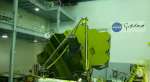 Webb Telescope Mirror Rises after Assembly
8.05.2016
Move over Hubble -- here comes the James Webb Space Telescope (JWST). JWST promises to be the new most powerful telescope in space. In the last month, the 18-segment gold-plated primary mirror for JWST was unveiled. In the featured time-lapse video taken last week, the 6.5-meter diameter mirror was raised to a vertical position.
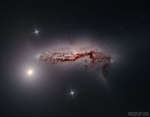 Galaxy Group Hickson 90
16.05.2017
Scanning the skies for galaxies, Canadian astronomer Paul Hickson and colleagues identified some 100 compact groups of galaxies, now appropriately called Hickson Compact Groups (HCGs). This sharp Hubble image shows one such galaxy group, HCG 90, in startling detail.
 Flemings Triangular Wisp
26.07.2021
Chaotic in appearance, these tangled filaments of shocked, glowing gas are spread across planet Earth's sky toward the constellation of Cygnus as part of the Veil Nebula. The Veil Nebula itself is a large supernova remnant, an expanding cloud born of the death explosion of a massive star.
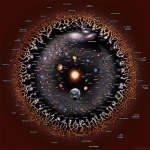 The Observable Universe
15.03.2022
How far can you see? Everything you can see, and everything you could possibly see, right now, assuming your eyes could detect all types of radiations around you -- is the observable universe. In light...
|
January February March April May June July August September October |
|||||||||||||||||||||||||||||||||||||||||||||||||