
|
You entered: stars
 A Protected Night Sky Over Flagstaff
16.04.2008
This sky is protected. Yesterday marked the 50 year anniversary of the first lighting ordinance ever enacted, which restricted searchlight advertisements from sweeping the night skies above Flagstaff, Arizona, USA. Flagstaff now enjoys...
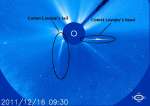 Comet Lovejoy: Sungrazing Survivor
17.12.2011
Like most other sungrazing comets, Comet Lovejoy (C/2011 W3) was not expected to survive its close encounter with the Sun. But it did. This image from a coronograph onboard the sun-staring SOHO spacecraft identifies the still inbound remnants of the tail, with the brilliant head or coma emerging from the solar glare on December 16.
 Aurora over New Zealand
26.02.2014
Sometimes the more you look at an image, the more you see. Such may be the case for this beautiful nighttime panorama taken last week in New Zealand. Visible right off, on the far left, are common clouds, slightly altered by the digital fusion of combining 11 separate 20-second exposures.
 APOD: 2023 November 21 Б Flemings Triangular Wisp
21.11.2023
These chaotic and tangled filaments of shocked, glowing gas are spread across planet Earth's sky toward the constellation of Cygnus as part of the Veil Nebula. The Veil Nebula itself is a large supernova remnant, an expanding cloud born of the death explosion of a massive star.
 Water Ice At The Lunar Poles
6.03.1998
After seven weeks in lunar orbit, instruments on board NASA's Lunar Prospector spacecraft have produced strong evidence for water ice on the Moon. While not in extensive sheets, this ice could be in the form of crystals, mixed in low concentrations with material in craters around the frigid North and South lunar poles.
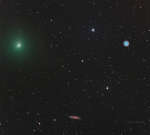 The Comet, the Owl, and the Galaxy
24.03.2017
Comet 41P/Tuttle-Giacobini-Kresak poses for a Messier moment in this telescopic snapshot from March 21. In fact it shares the 1 degree wide field-of-view with two well-known entries in the 18th century comet-hunting astronomer's famous catalog.
 Highlights of the Summer Sky
27.06.2018
What can you see in the night sky this summer? The featured graphic gives a few highlights for Earth's northern hemisphere. Viewed as a clock face centered at the bottom, early (northern) summer sky events fan out toward the left, while late summer events are projected toward the right.
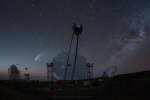 MAGIC NEOWISE
24.07.2020
The multi-mirror, 17 meter-diameter MAGIC telescopes reflect this starry night sky from the Roque de los Muchachos European Northern Observatory on the Canary Island of La Palma. MAGIC stands for Major Atmospheric Gamma Imaging...
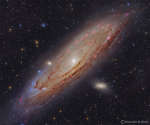 APOD: 2023 March 22 Б M31: The Andromeda Galaxy
22.03.2023
How far can you see? The most distant object easily visible to the unaided eye is M31, the great Andromeda Galaxy, over two million light-years away. Without a telescope, even this immense spiral galaxy appears as an unremarkable, faint, nebulous cloud in the constellation Andromeda.
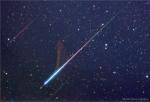 Fireball, Smoke Trail, Meteor Storm
22.11.2001
Returning from orbit, space shuttles enter the atmosphere at about 8 kilometers per second as friction heats their protective ceramic tiles to over 1,400 degrees Celsius. By contrast, the bits of comet dust...
|
January February March April May June July August September October |
|||||||||||||||||||||||||||||||||||||||||||||||||