
|
You entered: Earth's atmosphere
 Asteroids in the Distance
31.01.2021
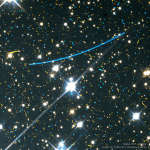
Rocks from space hit Earth every day. The larger the rock, though, the less often Earth is struck. Many kilograms of space dust pitter to Earth daily. Larger bits appear initially as a bright meteor. Baseball-sized rocks and ice-balls streak through our atmosphere daily, most evaporating quickly to nothing.
 Aurora Astern
30.11.1996
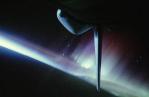
Sailing upside down, 115 nautical miles above Earth, the crew of the Space Shuttle Endeavour made this spectacular time exposure of the southern aurora (aurora australis) in October of 1994. The aurora, also known...
 Jupiter Eclipsing Ganymede
6.01.2009
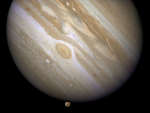
How hazy is Jupiter's upper atmosphere? To help find out, astronomers deployed the Hubble Space Telescope to watch Jupiter eclipse its moon Ganymede. Although Ganymede circles Jupiter once a week, it usually passes above or below the planet, so that a good eclipse occurs more rarely.
 Compton Observatory In Orbit
8.04.2000
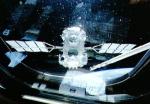
Nine years ago the massive Compton Gamma Ray Observatory was deployed in low earth orbit. Sparkling interior reflections and the bright limb of the Earth are visible in this 1991 window view of Compton's release by the crew of the Space Shuttle Atlantis.
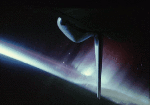 Aurora Astern
26.10.1995
Sailing upside down, 115 nautical miles above Earth, the crew of the Space Shuttle Endeavour made this spectacular time exposure of the southern aurora (aurora australis) in October of 1994. The aurora, also known...
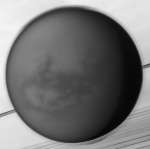 Titan: Moon over Saturn
9.01.2021
Like Earth's moon, Saturn's largest moon Titan is locked in synchronous rotation. This mosaic of images recorded by the Cassini spacecraft in May of 2012 shows its anti-Saturn side, the side always facing away from the ringed gas giant.
 Titan: Moon over Saturn
27.05.2022
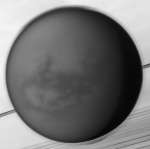
Like Earth's moon, Saturn's largest moon Titan is locked in synchronous rotation. This mosaic of images recorded by the Cassini spacecraft in May of 2012 shows its anti-Saturn side, the side always facing away from the ringed gas giant.
 Titan: Moon over Saturn
26.05.2018
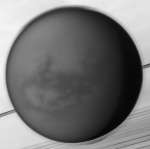
Like Earth's moon, Saturn's largest moon Titan is locked in synchronous rotation. This mosiac of images recorded by the Cassini spacecraft in May of 2012 show's its anti-Saturn side, the side always facing away from the ringed gas giant.
 Titan: Moon over Saturn
3.05.2025
Like Earth's moon, Saturn's largest moon Titan is locked in synchronous rotation with its planet. This mosaic of images recorded by the Cassini spacecraft in May of 2012 shows its anti-Saturn side, the side always facing away from the ringed gas giant.
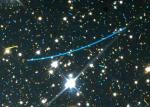 Asteroids in the Distance
23.06.2002
Rocks from space hit Earth every day. The larger the rock, though, the less often Earth is struck. Many kilograms of space dust pitter to Earth daily. Larger bits appear initially as a bright meteor. Baseball-sized rocks and ice-balls streak through our atmosphere daily, most evaporating quickly to nothing.
|
January February March April May June July August September October |
|||||||||||||||||||||||||||||||||||||||||||||||||