
|
You entered: Saturn
 Light at the End of the Road
1.09.2016
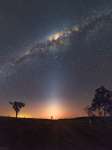
The bright light at the end of this country road is actually a remarkably close conjunction of two planets. After sunset on August 27 brilliant Venus and Jupiter almost appear as a single celestial beacon in the night skyscape taken near Lake Wivenhoe, Queensland, Australia.
 Cassini Spacecraft Approaches Jupiter
11.10.2000
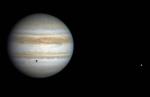
A new spacecraft has entered the outer Solar System: Cassini. Launched in 1997 and bound for Saturn in 2004, Cassini sent back the above image last week while approaching the giant planet Jupiter. Cassini joins the Galileo spacecraft currently in orbit around Jupiter in studying the gas giant and its moons.
 March of the Planets
25.03.1999
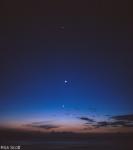
This March stargazers have been treated to eye-catching formations of bright planets in western evening skies. On March 3rd, looking toward a beautiful sunset from a beach on the Hawaiian isle of Maui, photographer Rick Scott recorded this fleeting, four-planet "hockey stick" array.
 An Atlas Centaur Rocket Launches
14.12.1995
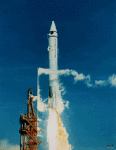
Atlas Centaur rockets have launched over 75 successful unmanned missions. These missions included the Surveyor series - the first vehicles to make soft landings on the Moon, Pioneer 10 and 11 - the first missions...
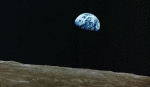 Earth Rise
25.12.1995
During the 1968 Christmas season Frank Borman, James Lovell, and William Anders flew the Apollo 8 command module From the Earth to the Moon and back (launched Dec. 21, achieved 10 lunar orbits, landed Dec. 27).
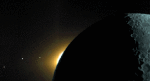 The Ecliptic Plane
21.09.1996
The Plane of the Ecliptic is illustrated in this Clementine star tracker camera image which reveals (from right to left) the Moon lit by Earthshine, the Sun's corona rising over the Moon's dark limb, and the planets Saturn, Mars, and Mercury.
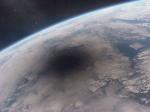 Looking Back at an Eclipsed Earth
10.06.2007
Here is what the Earth looks like during a solar eclipse. The shadow of the Moon can be seen darkening part of Earth. This shadow moved across the Earth at nearly 2000 kilometers per hour.
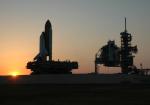 Discovery in Motion
8.07.2006
On July 4th, the space shuttle orbiter Discovery rocketed into space on mission STS-121. Now docked with the International Space Station, Discovery orbits planet Earth at about 27 thousand kilometers per hour.
 Five Planets at Castell de Burriac
6.02.2016
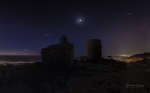
February's five planet line-up stretches across a clear sky in this predawn scene. A hilltop Castell de Burriac looms in the foreground, overlooking the town of Cabrera de Mar near Barcelona, Spain, planet Earth. The mosaicked, panoramic image looks south.
 Uranus: The Tilted Planet
26.08.2001
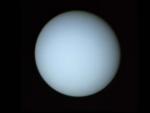
Uranus is the third largest planet in our Solar System after Jupiter and Saturn. Uranus is composed mostly of rock and ices, but with a thick hydrogen and helium atmosphere. The blue hue of Uranus' atmosphere arises from the small amount of methane which preferentially absorbs red light.
|
January February March April May June July August September October |
|||||||||||||||||||||||||||||||||||||||||||||||||