
|
You entered: dust lanes
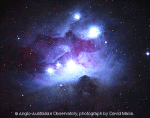 NGC 1977: Blue Reflection Nebula in Orion
20.03.1996
The Orion Nebula is visible to the unaided eye as a fuzzy patch near the famous belt of three stars in the constellation Orion. The above picture captures a part of the Orion Nebula that primarily reflects light from bright Orion stars.
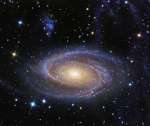 M81 and Arp s Loop
9.12.2010
One of the brightest galaxies in planet Earth's sky and similar in size to the Milky Way, big, beautiful spiral M81 lies 11.8 million light-years away in the northern constellation Ursa Major. This...
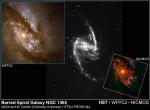 NGC 1365: Barred Spiral Galaxy
8.10.1999
NGC 1365 is a giant barred spiral galaxy about 200,000 light-years in diameter and 60 million light-years distant in the southern constellation Fornax. These three recently released images offer views of this majestic island universe in visible and infrared light.
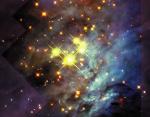 The Brown Dwarfs of Orions Trapezium
30.08.2000
The bright stars above are well known as heart of the Trapezium, an open cluster of stars in the center of the Orion Nebula. The many dim objects, however, are not well known, and have come to attention only on recent images in infrared light.
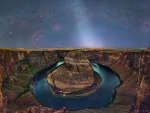 A Zodiacal Sky over Horseshoe Bend
22.05.2017
What's causing the unusual ray of white light extending upward from the central horizon? Dust orbiting the Sun. At certain times of the year, a band of sun-reflecting dust from the inner Solar System rises prominently before sunrise and is called zodiacal light.
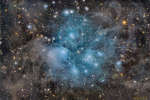 The Pleiades Deep and Dusty
25.02.2014
The well known Pleiades star cluster is slowly destroying part of a passing cloud of gas and dust. The Pleiades is the brightest open cluster of stars on Earth's sky and can be seen from almost any northerly location with the unaided eye.
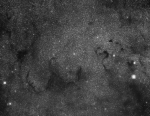 The Snake Nebula in Ophiuchus
11.08.1996
What slithers there? The dark curly lanes visible in part of the constellation Ophiuchus belong to the Snake Nebula. The Snake Nebula is a series of dark absorption clouds. Interstellar dust grains - composed predominantly of carbon - absorb visible starlight and reradiate much of it in the infrared.
 The Snake Nebula in Ophiuchus
24.08.1997
What slithers there? The dark winding lanes visible in part of the constellation Ophiuchus belong to the Snake Nebula. The Snake Nebula is a series of dark absorption clouds made up of Interstellar dust. Interstellar dust grains - composed predominantly of carbon - absorb visible starlight and reradiate much of it in the infrared.
 The Snake Nebula from CFHT
9.04.2002
What slithers overhead? The dark winding lanes visible in part of the constellation of Ophiuchus belong to the Snake Nebula. Also known as Barnard 72, the Snake Nebula is a series of dark absorption clouds made up of molecular gas and interstellar dust.
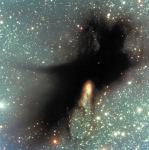 BHR 71: Stars, Clouds, and Jets
27.01.2003
What is happening to molecular cloud BHR 71? Quite possible, a binary star system is forming inside. Most stars in our Galaxy are part of binary star systems, but few have ever been seen in formation.
|
January February March April May June July August September |
|||||||||||||||||||||||||||||||||||||||||||||||||