
|
You entered: Ring Nebula
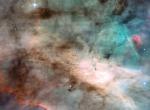 In the Center of the Omega Nebula
8.02.2004
In the depths of the dark clouds of dust and molecular gas known as the Omega Nebula, stars continue to form. The above image from the Hubble Space Telescope's Advanced Camera for Surveys shows exquisite detail in the famous star-forming region.
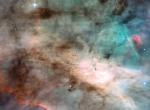 In the Center of the Omega Nebula
1.05.2002
In the depths of the dark clouds of dust and molecular gas known as the Omega Nebula, stars continue to form. The above image from the Hubble Space Telescope's newly installed Advanced Camera for Surveys shows unprecedented detail in the famous star-forming region.
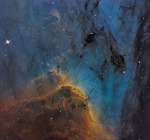 Pelican Nebula Close Up
26.11.2011
The prominent ridge of emission featured in this vivid skyscape is designated IC 5067. Part of a larger emission nebula with a distinctive shape, popularly called The Pelican Nebula, the ridge spans about 10 light-years and follows the curve of the cosmic pelican's head and neck.
 In the Center of the Omega Nebula
6.05.2012
In the depths of the dark clouds of dust and molecular gas known as the Omega Nebula, stars continue to form. The above image from the Hubble Space Telescope's Advanced Camera for Surveys shows exquisite detail in the famous star-forming region.
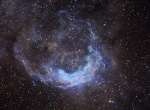 Windblown NGC 3199
22.05.2008
NGC 3199 lies about 12,000 light-years away, a glowing cosmic cloud in the southern constellation of Carina. The nebula is about 75 light-years across in this haunting, false-color view. Though the deep image...
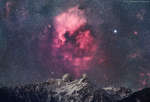 North American Nightscape
29.01.2021
On January 21, light from the Moon near first quarter illuminated the foreground in this snowy mountain and night scene. Known as The Lions, the striking pair of mountain peaks are north of Vancouver, British Colombia, Canada, North America, planet Earth.
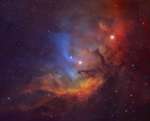 The Tulip in the Swan
26.07.2012
Framing a bright emission region this telescopic view looks out along the plane of our Milky Way Galaxy toward the nebula rich constellation Cygnus the Swan. Popularly called the Tulip Nebula the glowing cloud of interstellar gas and dust is also found in the 1959 catalog by astronomer Stewart Sharpless as Sh2-101.
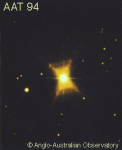 The Red Rectangle
2.11.1995
The unusual geometry of this stellar nebula creates somewhat of a mystery. At the nebula's center is a young binary star system that probably created the nebula, but how? This type of nebula shows a "bipolar flow" which carries a significant amount of mass away from the central stars.
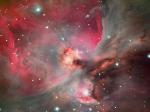 The Great Nebula in Orion
13.02.2002
Few astronomical sights excite the imagination like the nearby stellar nursery known as the Orion Nebula. The Nebula's glowing gas surrounds hot young stars at the edge of an immense interstellar molecular cloud only 1500 light-years away.
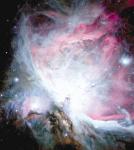 The Orion Nebula from CFHT
15.03.2004
Few astronomical sights excite the imagination like the nearby stellar nursery known as the Orion Nebula. The Nebula's glowing gas surrounds hot young stars at the edge of an immense interstellar molecular cloud only 1500 light-years away.
|
January February March April May June July August September October |
|||||||||||||||||||||||||||||||||||||||||||||||||