
|
You entered: dark cloud
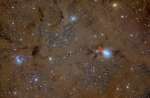 Stardust in Perseus
3.02.2010
This cosmic expanse of dust, gas, and stars covers close to 3 degrees on the sky in the heroic constellation Perseus. Right of center in the gorgeous skyscape is the dusty blue reflection nebula NGC 1333, about 1,000 light-years away. At that estimated distance, the field of view is about 50 light-years across.
 Messier 24: Sagittarius Star Cloud
27.06.2023
Unlike most entries in Charles Messier's famous catalog of deep sky objects, M24 is not a bright galaxy, star cluster, or nebula. It's a gap in nearby, obscuring interstellar dust clouds that allows a view of the distant stars in the Sagittarius spiral arm of our Milky Way galaxy.
 The North and South Jupiter
13.09.2016
A wide, looping orbit brought Juno close to Jupiter on August 27. As the spacecraft swung around the giant planet's poles JunoCam acquired these premier direct polar views, a change from the usual nearly equatorial perspective of outbound spacecraft and the telescopes of planet Earth.
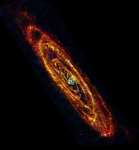 Herschel s Andromeda
2.02.2013
This infrared view from the Herschel Space Observatory explores the Andromeda Galaxy, the closest large spiral galaxy to our own Milky Way. Only 2.5 million light-years distant, the famous island universe is also known to astronomers as M31. Andromeda spans over 200,000 light-years making it more the twice the size of the Milky Way.
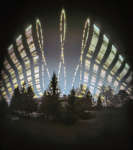 Solargraphic Analemmas
1.07.2022
For the northern hemisphere June 21 was the summer solstice, the Sun reaching its northernmost declination for the year. That would put it at the top of each of these three figure-8 curves, or analemmas, as it passed through the daytime sky over the village of Proboszczow, Poland.
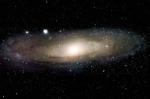 Andromeda Island Universe
18.05.2002
How far can you see? The most distant object easily visible to the unaided eye is M31, the great Andromeda Galaxy some two million light-years away. Without a telescope, even this immense spiral galaxy appears as an unremarkable, faint, nebulous cloud in the constellation Andromeda.
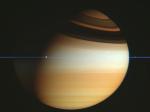 Cassini Spacecraft Crosses Saturns Ring Plane
4.05.2005
If this is Saturn, where are the rings? When Saturn's "appendages" disappeared in 1612, Galileo did not understand why. Later that century, it became understood that Saturn's unusual protrusions were rings and that when the Earth crosses the ring plane, the edge-on rings will appear to disappear.
 APOD: 2025 December 8 Б Flying Over the Earth at Night
7.12.2025
Many wonders are visible when flying over the Earth at night. Such visual spectacles occur every day for astronauts in low Earth orbit, but the featured video captured several from the International Space Station (ISS) in 2011 and set them to rousing music.
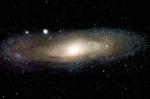 Andromeda Island Universe
8.09.2000
How far can you see? The most distant object easily visible to the unaided eye is M31, the great Andromeda Galaxy some two million light-years away. Without a telescope, even this immense spiral galaxy appears as an unremarkable, faint, nebulous cloud in the constellation Andromeda
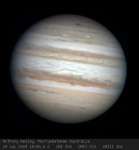 Jupiter s Impact Scar
23.07.2009
In July of 1994 pieces of Comet Shoemaker-Levy 9 collided with planet Jupiter. The explosive impacts sent plumes of debris high into the Jovian atmosphere creating dark markings or scars, visible for a time against the cloud bands.
|
January February March April May June July August September October |
|||||||||||||||||||||||||||||||||||||||||||||||||