
|
You entered: rings
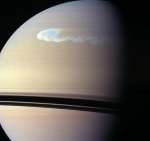 Saturn Storm
19.01.2011
Late last year, a new, remarkably bright storm erupted in Saturn's northern hemisphere. Amateur astronomers first spotted it in early December, with the ringed gas giant rising in planet Earth's predawn sky.
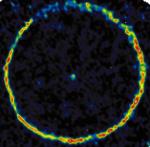 TT Cygni: Carbon Star
4.03.2001
TT Cygni is a cool red giant star with a wind. This false-color picture of TT Cyg was made using a coordinated array of millimeter wavelength radio telescopes and shows radio emission from carbon monoxide (CO) molecules in the surrounding gas.
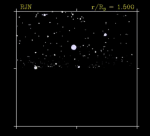 Circling a Black Hole at its Photon Sphere
2.07.2013
What would it look like to go right up to a black hole? One particularly interesting place near a black hole is its photon sphere, where photons can orbit in circles, a sphere 50 percent further out than the event horizon.
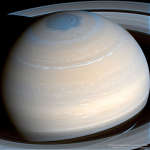 Saturn in Infrared from Cassini
3.04.2017
Many details of Saturn appear clearly in infrared light. Bands of clouds show great structure, including long stretching storms. Also quite striking in infrared is the unusual hexagonal cloud pattern surrounding Saturn's North Pole. Each side of the dark hexagon spans roughly the width of our Earth.
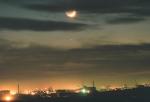 Moon Over Mongolia
9.02.2002
Fighting clouds and the glow of city lights, a young Moon shines over the western horizon of Mongolia's capital, Ulaan-Baatar. The thin sunlit crescent is about 2 days old and strongly over exposed in this image taken on March 10, 1997.
 The Lonely Neutron Star in Supernova E0102 72.3
30.09.2018
Why is this neutron star off-center? Recently a lone neutron star has been found within the debris left over from an old supernova explosion. The "lonely neutron star" in question is the blue dot at the center of the red nebula near the bottom left of E0102-72
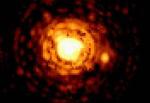 Small Star
5.06.1997
A dim double star system cataloged as Gliese 623 lies 25 light-years from Earth, in the constellation of Hercules. The individual stars of this binary system were distinguished for the first time when the Hubble Space Telescope's Faint Object Camera recorded this image in June 1994.
 Saturn in Infrared from Cassini
24.07.2022
Many details of Saturn appear clearly in infrared light. Bands of clouds show great structure, including long stretching storms. Also quite striking in infrared is the unusual hexagonal cloud pattern surrounding Saturn's North Pole. Each side of the dark hexagon spans roughly the width of our Earth.
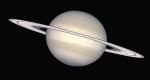 Natural Saturn On The Cassini Cruise
5.11.1998
What you could see approaching Saturn aboard an interplanetary cruise ship would closely resemble this subtly shaded view of the gorgeous ringed gas giant. Processed by the Hubble Heritage project, the picture intentionally avoids...
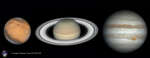 Three Planets from Pic du Midi
2.06.2016
Seen any planets lately? All three planets now shining brightly in the night sky are imaged in these panels, captured last week with the 1 meter telescope at Pic du Midi Observatory in the French Pyrenees.
|
January February March April May June July August September October |
|||||||||||||||||||||||||||||||||||||||||||||||||