
|
You entered: star system
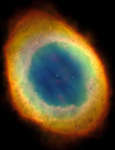 M57: The Ring Nebula
15.11.2009
It looks like a ring on the sky. Hundreds of years ago astronomers noticed a nebula with a most unusual shape. Now known as M57 or NGC 6720, the gas cloud became popularly known as the Ring Nebula.
 Orion and the Running Man
13.11.2025
Few cosmic vistas can excite the imagination like The Great Nebula in Orion. Visible as a faint, bland celestial smudge to the naked-eye, the nearest large star-forming region sprawls across this sharp colorful telescopic image. Designated M42 in the Messier Catalog, the Orion Nebula's glowing gas and dust surrounds hot, young stars.
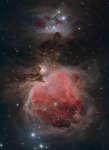 Orion and the Running Man
10.03.2023
Few cosmic vistas excite the imagination like The Great Nebula in Orion. Visible as a faint celestial smudge to the naked-eye, the nearest large star-forming region sprawls across this sharp telescopic image, recorded on a cold January night in dark skies from West Virginia, planet Earth.
 APOD: 2025 August 9 Б Interstellar Interloper 3I/ATLAS from Hubble
9.08.2025
Discovered on July 1 with the NASA-funded ATLAS (Asteroid Terrestrial-impact Last Alert System) survey telescope in Rio Hurtado, Chile, 3I/ATLAS is so designated as the third known interstellar object to pass through our Solar System. It follows 1I/йOumuamua in 2017 and the comet 2I/Borisov in 2019.
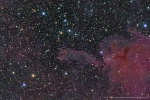 Cometary Globule CG4
5.03.2015
The faint and somehow menacing cometary globule CG4 reaches through the center of this deep southern skyscape. About 1,300 light-years from Earth toward the constellation Puppis, its head is about 1.5 light-years in diameter and its tail about 8 light-years long.
 APOD: 2025 September 26 Б A SWAN an ATLAS and Mars
26.09.2025
A new visitor to the inner Solar System, comet C/2025 R2 (SWAN) sports a long ion tail extending diagonally across this almost 7 degree wide telescopic field of view recorded on September 21.
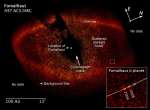 Fomalhaut b
14.11.2008
Fomalhaut (sounds like "foam-a-lot") is a bright, young, star, a short 25 light-years from planet Earth in the direction of the constellation Piscis Austrinus. In this sharp composite from the Hubble Space Telescope, Fomalhaut...
 Seven Jets from Comet Hale-Bopp
13.11.1996
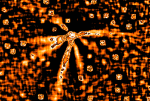
Comet Hale-Bopp is turning out to be quite unusual. One reason is the great amount of jet activity at such a large distance from the Sun. In the above false-color image, no less than seven jets can be seen emanating from Hale-Bopp's coma.
 NGC 3242: The Ghost of Jupiter
29.10.2005
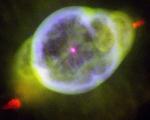
After a star like the Sun completes fusion in its core, it throws off its outer layers in a brief, beautiful cosmic display called a planetary nebula. NGC 3242 is such a planetary nebula, with the stellar remnant white dwarf star visible at the center.
 Outbound Comet ZTF
24.03.2023
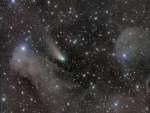
Former darling of the northern sky Comet C/2022E3 (ZTF) has faded. During its closest approach to our fair planet in early February Comet ZTF was a mere 2.3 light-minutes distant. Then known as the green comet, this visitor from the remote Oort Cloud is now nearly 13.3 light-minutes away.
|
January February March April May June July August September October |
|||||||||||||||||||||||||||||||||||||||||||||||||