
|
You entered: stars
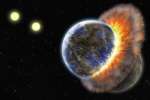 The Case of the Very Dusty Binary Star
25.09.2008
For astronomers, close binary star system BD+20 307 originally stood out because it is extremely dusty. A substantial amount of warm dust surrounding it causes the system to appear exceptionally bright at infrared wavelengths. Of course, dust associated with planet formation is often detected around young stars, stars only a few million years old.
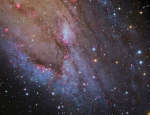 NGC 206 and the Star Clouds of Andromeda
25.09.2014
The large stellar association cataloged as NGC 206 is nestled within the dusty arms of the neighboring Andromeda galaxy. Also known as M31, the spiral galaxy is a mere 2.5 million light-years away.
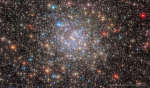 APOD: 2023 January 30 Б Globular Star Cluster NGC 6355 from Hubble
30.01.2023
Globular clusters once ruled the Milky Way. Back in the old days, back when our Galaxy first formed, perhaps thousands of globular clusters roamed our Galaxy. Today, there are less than 200 left. Over the eons, many globular clusters were destroyed by repeated fateful encounters with each other or the Galactic center.
 APOD: 2025 September 13 Б Star Trails over One Mile Radio Telescope
13.09.2025
The steerable 60 foot diameter dish antenna of the One-Mile Telescope at Mullard Radio Astronomy Observatory, Cambridge, UK, is pointing skyward in this evocative night-skyscape. To capture the dramatic scene, consecutive 30 second exposures were recorded over a period of 90 minutes.
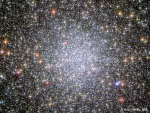 Globular Star Cluster 47 Tuc
19.05.2015
Globular star cluster 47 Tucanae is a jewel box of the southern sky. Also known as NGC 104, it roams the halo of our Milky Way Galaxy along with over 150 other globular star clusters.
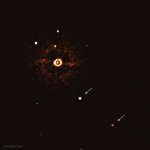 APOD: 2020 August 18 Б TYC 8998 760 1: Multiple Planets around a Sun Like Star
18.08.2020
Do other stars have planets like our Sun? Previous evidence shows that they do, coming mostly from slight shifts in the star's light created by the orbiting planets. Recently, however, and for the first time, a pair of planets has been directly imaged around a Sun-like star.
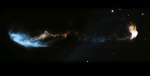 HH 47: A Young Star Jet Expands
5.09.2011
Stars remain where they are. Nebulas appear the same. Day after day. Year after year. Given the vast distances in astronomy, even fast moving objects will not appear to change their appearance in a human lifetime. Typically. A recent spectacular exception to this, however, is the supersonic jet in the star forming Herbig Haro 47.
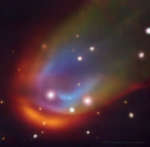 APOD: 2026 February 16 Б Unexplained Shocks Around a White Dwarf Star
16.02.2026
How is RXJ0528+2838 creating such shock waves? A recently discovered white dwarf star, the farther left of the two largest white spots, RXJ0528+2838, was found 730 light-years away from Earth. Most stars...
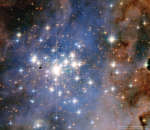 Young Star Cluster Trumpler 14 from Hubble
14.05.2019
Why does star cluster Trumpler 14 have so many bright stars? Because it is so young. Many cluster stars have formed only in the past 5 million years and are so hot they emit detectable X-rays.
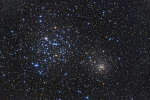 Open Star Clusters M35 and NGC 2158
3.01.2013
Open clusters of stars can be near or far, young or old, and diffuse or compact. Found near the plane of our Milky Way galaxy, they contain from 100 to 10,000 stars, all of which formed at nearly the same time. Bright blue stars frequently distinguish younger open clusters.
|
January February March April May June July August September October |
|||||||||||||||||||||||||||||||||||||||||||||||||