
|
You entered: Earth's atmosphere
 Asteroid 2004 FH Whizzes By
22.03.2004
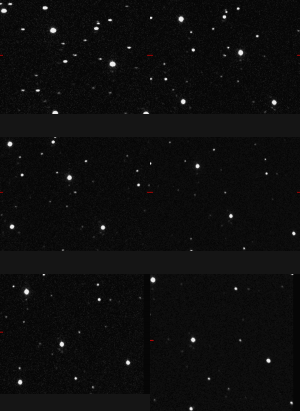
Last week, a small asteroid approached unusually close to the Earth. Asteroid 2004 FH posed no danger, but became bright enough to see with binoculars. Passing only 7 Earth radii away, this asteroid pass was the closest yet that was previously predicted, although it was discovered only two days before.
 Lunar Transit from STEREO
3.03.2007
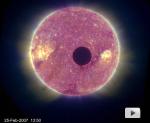
A million miles from planet Earth, last weekend the STEREO B spacecraft found itself in the shadow of the Moon. So, looking toward the Sun, extreme ultraviolet cameras onboard STEREO B were able to record a stunning movie of a lunar transit (aka solar eclipse), as the Moon tracked across the solar disk.
 Europa: Oceans of Life?
6.08.1996
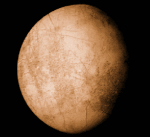
Is there life beneath Europa's frozen surface? Some believe the oceans found there of carbon-enriched water are the best chance for life, outside the Earth, in our Solar System. Europa, the fourth largest moon of Jupiter, was recently discovered to have a thin oxygen atmosphere by scientists using the Hubble Space Telescope.
 Saturnian Aurora
23.01.1999
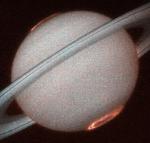
Girdling the second largest planet in the Solar System, Saturn's Rings are one of the most spectacular sights for earthbound telescopes. This image from the orbiting Hubble Space Telescope's STIS instrument, offers a striking view of another kind of ring around Saturn - pole encircling rings of ultraviolet aurora.
 Night Shinings
2.07.2008
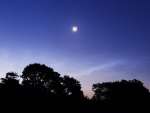
In the early morning hours of June 30th, ghostly clouds hovered in the east in this view of near dawn skies over western France. The noctilucent or night-shining clouds lie near the edge of space, reflecting sunlight from about 80 kilometers above Earth's surface.
 Saturnian Aurora
23.12.2001
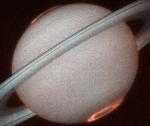
the second largest planet in the Solar System, Saturn's Rings are one of the most spectacular sights for earthbound telescopes. This image from the orbiting Hubble Space Telescope's STIS instrument, offers a striking view of another kind of ring around Saturn - pole encircling rings of ultraviolet aurora.
 Stars and the Solstice Sun
21.06.2007
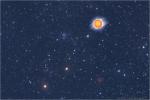
If you could turn off the atmosphere's ability to scatter overwhelming sunlight, today's daytime sky might look something like this ... with the Sun surrounded by the stars of the constellations Taurus and Gemini. Of course, today is the Solstice.
 Saturnian Aurora
9.01.1998
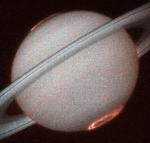
Girdling the second largest planet in the Solar System, Saturn's Rings are one of the most spectacular sights for earthbound telescopes. This recently released image, from the orbiting Hubble Space Telescope's STIS instrument, offers a striking view of another kind of ring around Saturn - pole encircling rings of ultraviolet aurora.
 Saturnian Aurora
17.09.2000
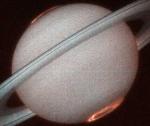
Girdling the second largest planet in the Solar System, Saturn's Rings are one of the most spectacular sights for earthbound telescopes. This image from the orbiting Hubble Space Telescope's STIS instrument, offers a striking view of another kind of ring around Saturn - pole encircling rings of ultraviolet aurora.
 La Superba
18.12.2008
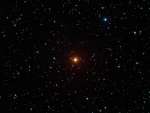
Y Canum Venaticorum (Y CVn) is a very rare star in planet Earth's night sky. It's also very red, exhibiting such a remarkable spectrum of light, 19th century astronomer Angelo Secchi dubbed it La Superba.
|
January February March April May June July August September October |
|||||||||||||||||||||||||||||||||||||||||||||||||