
|
You entered: Earth orbit
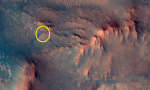 APOD: 2026 June 27 Б Mars Marathon by Perseverance
27.06.2026
In this recent HiRISE view from the Mars Reconnaissance Orbiter, the little green dot indicated on the surface of the big Red Planet is the Perseverance Mars rover. Recorded on June 13, the car-sized...
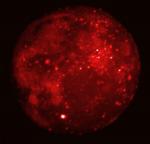 Eclipsed Moon in Infrared
10.01.1997
Last September's total lunar eclipse disappointed many observers in the Eastern and Midwestern US who were cursed with cloudy skies. However, the Midcourse Space Experiment (MSX) satellite had a spectacular view from Earth orbit and SPIRIT III, an onboard imaging infrared telescope, was used to repeatedly image the moon during the eclipse.
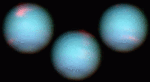 The Clouds of Neptune
7.05.1996
These Hubble Space Telescope (HST) images reveal glimpses of the dynamic atmosphere of Neptune, the Solar System's most distant gas giant planet. The first close-up of Neptune's clouds was provided by NASA's Voyager 2 spacecraft during its August 1989 flyby, giving a tantalizingly brief look.
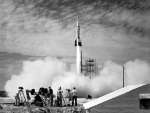 The First Rocket Launch from Cape Canaveral
1.10.2008
A new chapter in space flight began on 1950 July with the launch of the first rocket from Cape Canaveral, Florida: the Bumper 2. Shown above, the Bumper 2 was an ambitious two-stage rocket program that topped a V-2 missile base with a WAC Corporal rocket.
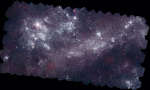 The Large Magellanic Cloud in Ultraviolet
10.06.2013
Where are the hottest stars in the nearest galaxies? To help find out, NASA commissioned its Earth-orbiting Swift satellite to compile a multi-image mosaic of the neighboring Large Magellanic Cloud (LMC) galaxy in ultraviolet light.
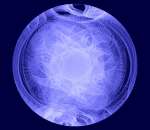 Fermi Epicyles: The Vela Pulsar s Path
4.05.2012
Exploring the cosmos at extreme energies, the Fermi Gamma-ray Space Telescope orbits planet Earth every 95 minutes. By design, it rocks to the north and then to the south on alternate orbits in order to survey the sky with its Large Area Telescope (LAT).
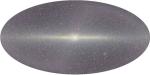 The Near Infrared Sky
18.05.2000
Was this picture taken from outside our Galaxy? No, it is a composite taken from Earth orbit, well inside our Milky Way Galaxy. In light just a little too red for human eyes...
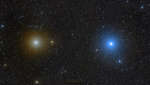 Gemini Stars Pollux and Castor
16.05.2017
Who are the twins of Gemini? It terms of astronomical objects, the famous constellation is dominated by two bright stars: Pollux (left) and Castor (right). Pictured, the two stars stand out because they are so bright, so close together both in angle and brightness, but so different in color.
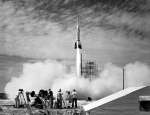 The First Rocket Launch from Cape Canaveral
19.07.2015
A new chapter in space flight began this week in 1950 July with the launch of the first rocket from Cape Canaveral, Florida: the Bumper V-2. Shown above, the Bumper V-2 was an ambitious two-stage rocket program that topped a V-2 missile base with a WAC Corporal rocket.
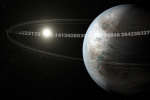 APOD: 2026 March 14 Б A Year for K2-315b
14.03.2026
Want to visit a planet that has 3.14 days in a year? Then plan a trip to K2-315b, an earth-sized planet orbiting around a cool, red, M dwarf star about once every 3.14 days.
|
January February March April May June July August September October |
|||||||||||||||||||||||||||||||||||||||||||||||||