
|
You entered: cluster
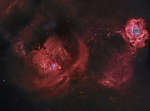 Field of Rosette
14.02.2010
What surrounds the florid Rosette nebula? To better picture this area of the sky, the famous flowery emission nebula on the far right has been captured recently in a deep and dramatic wide field image that features several other sky highlights.
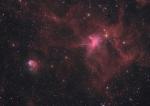 The Spider and The Fly
27.10.2006
Star clusters and nebulae abound in the ancient northern constellation Auriga - a region that includes the interesting pair NGC 1931 (lower left) and IC 417. In this gorgeous color image, an imaginative eye toward the expansive IC 417 and diminutive NGC 1931 suggests a cosmic spider and fly.
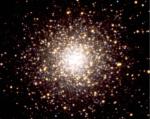 M3: Half A Million Stars
17.09.1999
This immense ball of half a million stars older than the sun lies 30,000 light-years above the plane of our Galaxy. Cataloged as M3 (and NGC 5272), it is one of about 250 globular star clusters which roam our galactic halo.
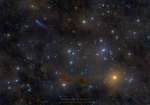 Blue Comet in the Hyades
18.01.2018
Stars of the Hyades cluster are scattered through this mosaic spanning over 5 degrees on the sky toward the constellation Taurus. Presently cruising through the Solar System, the remarkably blue comet C/2016 R2 PanSTARRS is placed in the wide field of view using image data from January 12.
 APOD: 2025 August 13 Б Trapezium: In the Heart of Orion
13.08.2025
What lies in the heart of Orion? Trapezium: four bright stars, that can be found near the center of this sharp cosmic portrait. Gathered within a region about 1.5 light-years in radius, these stars dominate the core of the dense Orion Nebula Star Cluster.
 White Dwarf Stars Cool
10.09.2000
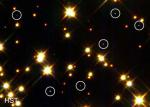
Diminutive by stellar standards, white dwarf stars are also intensely hot ... but they are cooling. No longer do their interior nuclear fires burn, so they will continue to cool until they fade away. This Hubble Space Telescope image covers a small region near the center of a globular cluster known as M4.
 M8: In the Center of the Lagoon Nebula
3.01.2001
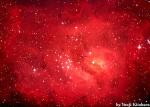
In the center of the Lagoon Nebula one finds glowing gas, star clusters, and dense knots of gas and dust just now forming stars. The young open cluster of stars, designated NGC 6523, can be seen in the center of the above image. These stars emit energetic light that ionizes the surrounding hydrogen gas.
 APOD: 2025 January 27 Б Pleiades over Half Dome
27.01.2025
Stars come in bunches. The most famous bunch of stars on the sky is the Pleiades, a bright cluster that can be easily seen with the unaided eye. The Pleiades lies only about 450 light years away, formed about 100 million years ago, and will likely last about another 250 million years.
 SN Requiem: A Supernova Seen Three Times So Far
2.11.2021
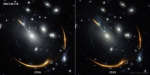
We've seen this same supernova three times -- when will we see it a fourth? When a distant star explodes in a supernova, we're lucky if we see it even once.
 Planetary Nebula NGC 2438
7.04.2011
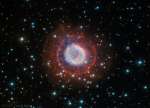
NGC 2438 is a planetary nebula, the gaseous shroud cast off by a dying sunlike star billions of years old whose central reservoir of hydrogen fuel has been exhausted. About 3,000 light-years distant it lies within the boundaries of the nautical constellation Puppis.
|
January February March April May June July August September October |
|||||||||||||||||||||||||||||||||||||||||||||||||