
|
You entered: full moon
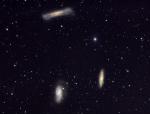 Trio Leo
9.03.2006
This popular group is famous as the Leo Triplet - a gathering of three magnificent galaxies in one field of view. Crowd pleasers when imaged with even modest telescopes, these galaxies can be introduced individually as NGC 3628 (top), M66 (bottom left), and M65 (bottom right). All three are large spiral galaxies.
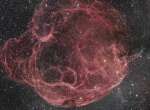 Simeis 147: Supernova Remnant
12.02.2011
It's easy to get lost following the intricate filaments in this detailed mosaic image of faint supernova remnant Simeis 147. Also cataloged as Sh2-240 and seen towards the constellation Taurus, it covers nearly 3 degrees (6 full moons) on the sky.
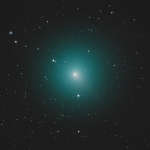 Comet 46P Wirtanen
15.11.2018
Periodic Comet 46P/Wirtanen is now the brightest comet in the night sky, but too faint to be seen by eye. From dark sky sites it could just become naked-eye visible though, as it's 5.4 year long looping orbit takes it closest to Earth and the Sun in mid December.
 Solar Eclipse from a Ship
29.04.2023
Along a narrow path that mostly avoided landfall, the shadow of the New Moon raced across planet Earth's southern hemisphere on April 20 to create a rare annular-total or hybrid solar eclipse. From...
 APOD: 2025 June 2 Б Veil Nebula: Wisps of an Ancient Supernova
2.06.2025
Wisps like this are all that remain visible of a Milky Way star. About 7,000 years ago that star exploded in a supernova, leaving the Veil Nebula. At the time, the expanding cloud was likely as bright as a crescent Moon, remaining visible for weeks to people living at the dawn of recorded history.
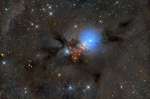 NGC 1333: Stellar Nursery in Perseus
5.11.2015
NGC 1333 is seen in visible light as a reflection nebula, dominated by bluish hues characteristic of starlight reflected by interstellar dust. A mere 1,000 light-years distant toward the heroic constellation Perseus, it lies at the edge of a large, star-forming molecular cloud.
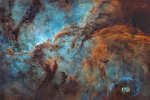 APOD: 2026 July 7 Б NGC 6188: Dragons of Ara
7.07.2026
Where can you find dragons fighting in the night sky? In the southern constellation of the Altar: Ara. The dragons are, of course, actually made of suggestively shaped gas and dust. The celestial home...
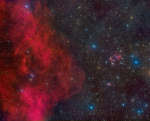 Barnard Stares at NGC 2170
19.01.2013
A gaze across a cosmic skyscape, this telescopic mosaic reveals the continuous beauty of things that are. The evocative scene spans some 6 degrees or 12 Full Moons in planet Earth's sky. At the left, folds of red, glowing gas are a small part of an immense, 300 light-year wide arc.
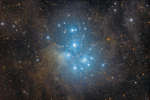 M45: The Pleiades Star Cluster
18.09.2013
Have you ever seen the Pleiades star cluster? Even if you have, you probably have never seen it as dusty as this. Perhaps the most famous star cluster on the sky, the bright stars of the Pleiades can be seen without binoculars from even the depths of a light-polluted city.
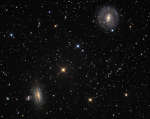 NGC 5078 and Friends
25.05.2016
This sharp telescopic field of view holds two bright galaxies. Barred spiral NGC 5101 (top right) and nearly edge-on system NGC 5078 are separated on the sky by about 0.5 degrees or about the apparent width of a full moon.
|
January February March April May June July August September October |
|||||||||||||||||||||||||||||||||||||||||||||||||