
|
You entered: unusual
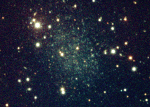 Antlia: A New Galactic Neighbor
23.04.1997
Meet Antlia, a newly discovered neighbor of our Milky Way Galaxy. Announced just last week, this faint member of our Local Group of Galaxies has only about one million stars. It is late in being noticed because it is so hard to see against a bright sky.
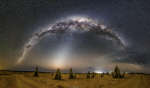 Milky Way and Zodiacal Light over Australian Pinnacles
10.10.2017
What strange world is this? Earth. In the foreground of the featured image are the Pinnacles, unusual rock spires in Nambung National Park in Western Australia. Made of ancient sea shells (limestone), how these human-sized picturesque spires formed remains a topic of research. The panorama was taken last month.
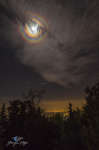 A Lunar Corona over Turin
16.09.2019
What are those colorful rings around the Moon? A corona. Rings like this will sometimes appear when the Moon is seen through thin clouds. The effect is created by the quantum mechanical diffraction of light around individual, similarly-sized water droplets in an intervening but mostly-transparent cloud.
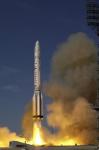 A Russian Proton Rocket Launches Zvezda
18.07.2000
The Russian Proton rocket is the tallest rocket in routine use. First deployed in 1965, the rocket stands typically 40 meters tall, can carry unusually heavy payloads into space, and maintains a high record of reliability.
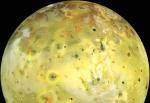 Io in True Color
15.07.2001
The strangest moon in the Solar System is bright yellow. This picture, showing Io's true colors, was taken in 1999 July by the Galileo spacecraft currently orbiting Jupiter. Io's colors derive from sulfur and molten silicate rock. The unusual surface of Io is kept very young by its system of active volcanoes.
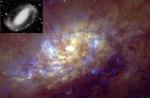 Starbirth in NGC 1808
23.03.1998
The center of galaxy NGC 1808 is bursting with new stars, but why? Being a barred spiral galaxy makes NGC 1808 somewhat similar to our own Milky Way Galaxy. But the disk of NGC 1808 (inset) is quite warped, and its center is unusually bright and blue.
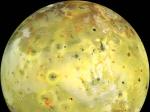 Io in True Color
2.05.2004
The strangest moon in the Solar System is bright yellow. This picture, showing Io's true colors, was taken in 1999 July by the Galileo spacecraft that orbited Jupiter from 1995 to 2003. Io's colors derive from sulfur and molten silicate rock.
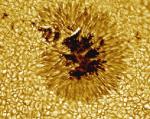 A Sunspot Up Close
5.10.1998
Sometimes, small regions of the Sun appear unusually dark. Visible above is a close-up picture of a sunspot, a depression on the Sun's face that is slightly cooler and less luminous than the rest of the Sun.
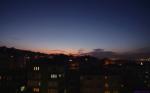 Venus Just After Sunset
1.02.2006
Is that Venus or an airplane? A common ponderable for sky enthusiasts is deciding if that bright spot near the horizon is the planet Venus. Usually, an airplane will show itself by moving significantly in a few moments. Venus will set only slowly as the Earth turns.
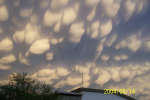 Mammatus Clouds Over Mexico
30.12.2007
Normal cloud bottoms are flat because moist warm air that rises and cools will condense into water droplets at a very specific temperature, which usually corresponds to a very specific height. After water droplets form that air becomes an opaque cloud.
|
January February March April May June July August |
||||||||||||||||||||||||||||||||||||||||||||||||||||||||