
|
You entered: Earth
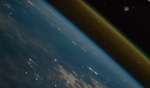 Rocket Launch as Seen from the Space Station
26.11.2018
Have you ever seen a rocket launch -- from space? A close inspection of the featured time-lapse video will reveal a rocket rising to Earth orbit as seen from the International Space Station (ISS).
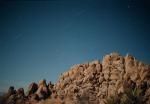 Leonids Over Indian Cove
18.11.2003
One year ago today an impressive meteor shower graced the skies of Earth. Pictured above from last year, at least six bright meteors are visible in only part of the sky above Indian Cove campground in California, USA, during a four-minute exposure.
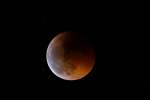 Eclipsed Moonlight
21.06.2011
A celestial prelude to today's solstice, the June 15 total lunar eclipse was one of the longest in recent years. It was also one of the darkest, but not completely dark. Even during...
 APOD: 2025 September 25 Б Saturn Opposite the Sun
25.09.2025
This year Saturn was at opposition on September 21, opposite the Sun in planet Earth's sky. At its closest to Earth, Saturn was also at its brightest of the year, rising as the Sun set and shining above the horizon all night long among the fainter stars of the constellation Pisces.
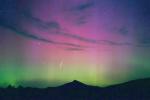 A Perseid Aurora
21.08.2000
Just after the Moon set but before the Sun rose in the early morning hours of August 12, meteors pelted the Earth from the direction of the constellation Perseus, while ions pelted the Earth from the Sun.
 Retrograde Mars
11.05.2008
Why would Mars appear to move backwards? Most of the time, the apparent motion of Mars in Earth's sky is in one direction, slow but steady in front of the far distant stars. About every two years, however, the Earth passes Mars as they orbit around the Sun.
 APOD: 2024 May 15 Б AR 3664 at the Suns Edge
15.05.2024
What did the monster active region that created the recent auroras look like when at the Sun's edge? There, AR 3664 better showed its 3D structure. Pictured, a large multi-pronged solar prominence...
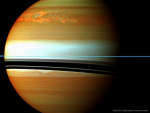 APOD: 2025 October 5 Б A Long Storm System on Saturn
5.10.2025
It was one of the largest and longest lived storms ever recorded in our Solar System. First seen in late 2010, the featured cloud formation in the northern hemisphere of Saturn started larger than the Earth and soon spread completely around the planet.
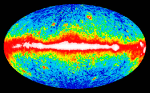 Gamma Ray Sky Map
23.06.1995
What if you could "see" gamma rays? This computer processed image represents a map of the entire sky at photon energies above 100 million electron Volts. These gamma-ray photons are more than 40 million times more energetic than visible light photons and are blocked from the Earth's surface by the atmosphere.
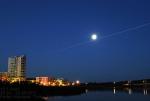 Moons and Bright Mars
1.08.2003
In this serene view, the moons of Earth along with the bright planet Mars shine above the city of Turku near the southwestern tip of Finland. Of course Earth's large natural satellite, the Moon, at a distance of 400,000 kilometers, is by far the brightest object in this sky.
|
January February March April May June July August September October |
|||||||||||||||||||||||||||||||||||||||||||||||||