
|
You entered: Earth's moon
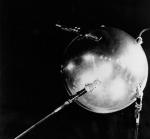 Sputnik: Traveling Companion
3.10.1998
Sputnik means "traveling companion". Despite the innocuous sounding name, the launch of the Earth's first "artificial moon", Sputnik 1, by the Soviets on October 4, 1957 shocked the free world, setting in motion events which resulted in the creation of NASA and the race to the Moon.
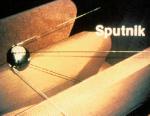 Sputnik: Traveling Companion
27.04.1997
Sputnik means "traveling companion". Despite the innocuous sounding name, the launch of the Earth's first "artificial moon", Sputnik 1, by the Soviets on October 4, 1957 shocked the free world, setting in motion events which resulted in the creation of NASA and the race to the Moon.
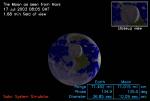 Mars Simulated View
16.07.2003
When earthdweller Patrick Vantuyne wondered what his home planet's single large moon would look like if viewed from Mars on July 17, he availed himself of the JPL Solar System Simulator. Of course...
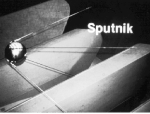 Sputnik: The Traveling Companion
11.02.1996
Sputnik means "traveling companion". In stark contrast to this innocent sounding name, the launch of the Earth's first "artificial moon", Sputnik 1, by the Soviets on October 4, 1957 shocked the free world, setting in motion events which resulted in the creation of NASA and the race to the Moon.
 Odysseus on the Moon
2.03.2024
Methalox rocket engine firing, Odysseus' landing legs absorb first contact with the lunar surface in this wide-angle snapshot from a camera on board the robotic Intuitive Machines Nova-C moon lander. Following the landing on February 22, broken landing legs, visible in the image, ultimately left the lander at rest but tilted.
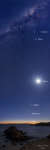 Five Planets and the Moon over Australia
16.08.2016
It is not a coincidence that planets line up. That's because all of the planets orbit the Sun in (nearly) a single sheet called the plane of the ecliptic. When viewed from inside that plane -- as Earth dwellers are likely to do -- the planets all appear confined to a single band.
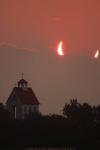 Clouds and the Moon Move to Block the Sun
18.06.2003
High above a small church near Vienna, Austria, clouds and the Moon vied for position in front of the Sun. Such was the case on the ground late last month during a partial eclipse of the Sun visible throughout Europe and Asia.
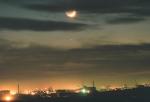 Moon Over Mongolia
9.02.2002
Fighting clouds and the glow of city lights, a young Moon shines over the western horizon of Mongolia's capital, Ulaan-Baatar. The thin sunlit crescent is about 2 days old and strongly over exposed in this image taken on March 10, 1997.
 Solar Eclipse
12.06.2025
On April 20, 2023 the shadow of a New Moon raced across planet Earth's southern hemisphere. When viewed along a narrow path that mostly avoided landfall, the Moon in silhouette created a hybrid solar eclipse.
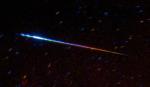 A Perseid Meteor
12.08.2000
This weekend, the annual Perseid Meteor Shower reaches its maximum. Grains of cosmic sand and gravel shed from Comet Swift-Tuttle will streak across the sky as they vaporize during entry into Earth's atmosphere. The Perseids result from the yearly
|
January February March April May June July August September |
|||||||||||||||||||||||||||||||||||||||||||||||||