
|
You entered: Earth orbit
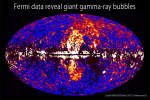 Huge Gamma Ray Bubbles Found Around Milky Way
9.11.2010
Did you know that our Milky Way Galaxy has huge bubbles emitting gamma rays from the direction of the galactic center? Neither did anybody. As the data from the Earth-orbiting Fermi satellite began acuminating over the past two years, however, a large and unusual feature toward our Galaxy's center became increasingly evident.
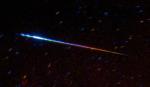 A Perseid Meteor
12.08.2000
This weekend, the annual Perseid Meteor Shower reaches its maximum. Grains of cosmic sand and gravel shed from Comet Swift-Tuttle will streak across the sky as they vaporize during entry into Earth's atmosphere. The Perseids result from the yearly
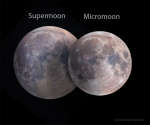 APOD: 2026 May 30 Б Supermoon Versus Micromoon
29.05.2026
What is so micro about tonight's blue micromoon? Just after sunset, a full moon will appear slightly smaller and dimmer than usual. The reason is that the Moon's fully illuminated phase occurs within a short time of apogee - when the Moon is farthest from the Earth in its elliptical orbit.
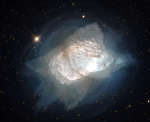 Bright Planetary Nebula NGC 7027 from Hubble
26.08.2013
It is one of the brightest planetary nebulae on the sky -- what should it be named? First discovered in 1878, nebula NGC 7027 can be seen toward the constellation of the Swan (Cygnus) with a standard backyard telescope.
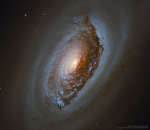 M64: The Evil Eye Galaxy
28.03.2021
Who knows what evil lurks in the eyes of galaxies? The Hubble knows -- or in the case of spiral galaxy M64 -- is helping to find out. Messier 64, also known as the Evil...
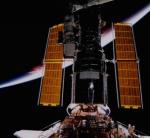 Hubble Holiday
23.12.1999
How would you like to spend your holiday in low earth orbit? That's what the crew of the space shuttle Discovery is doing as they deliver six new gyros and a faster main computer to the orbiting Hubble Space Telescope.
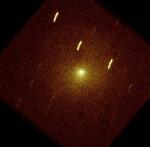 A Swift Look at Tempel 1
3.07.2005
Comet Tempel 1 is targeted for a collision with the impactor probe from NASA's Deep Impact Spacecraft at about 1:52am EDT on July 4th (other time zones). Cameras on the impactor probe...
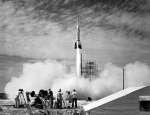 The First Rocket Launch from Cape Canaveral
30.09.2018
A new chapter in space flight began in 1950 with the launch of the first rocket from Cape Canaveral, Florida: the Bumper V-2. Featured here, the Bumper V-2 was an ambitious two-stage rocket program that topped a V-2 missile base with a WAC Corporal rocket.
 APOD: 2025 May 21 Б International Space Station Crosses the Sun
20.05.2025
Typically, the International Space Station is visible only at night. Slowly drifting across the night sky as it orbits the Earth, the International Space Station (ISS) can be seen as a bright spot about once a month from many locations.
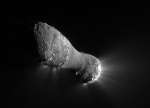 700 Kilometers Below Comet Hartley 2
7.11.2010
What kind of comet is this? Last week, NASA's robotic EPOXI spacecraft whizzed past Comet 103P/Hartley, also known as Comet Hartley 2, and recorded images and data that are both strange and fascinating. EPOXI was near its closest approach -- about 700 kilometers away -- when it snapped the above picture.
|
January February March April May June July August September October |
|||||||||||||||||||||||||||||||||||||||||||||||||