
|
You entered: Mars
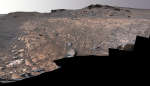 Perseverance in Jezero Crater s Delta
17.09.2022
The Perseverance rover's Mastcam-Z captured images to create this mosaic on August 4, 2022. The car-sized robot was continuing its exploration of the fan-shaped delta of a river that, billions of years ago, flowed into Jezero Crater on Mars.
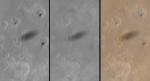 The Shadow of Phobos
29.03.2003
Hurtling through space above the Red Planet, potato-shaped Phobos completes an orbit of Mars in less than eight hours. In fact, since its orbital period is shorter than the planet's rotation period, Mars-based...
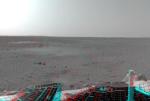 Spirit s 3D View Towards Sleep Hollow
6.01.2004
Working late, tired mission members nicknamed the smooth-looking depression to the left of center in this image from the martian surface, Sleepy Hollow. The picture is a portion of the 3D panorama of the Spirit rover's landing site released yesterday, constructed with data from the Mars rover's navigation cameras.
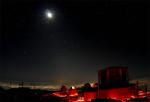 Moon Over Haleakala
10.06.2006
A waxing crescent Moon shines over the caldera of dormant volcano Haleakala and observatory domes in this dramatic view from above the clouds. Looking west from Maui, Hawaii on May 31st, the scene also records the lights of Honolulu on the horizon.
 Shadow Of Phobos
5.11.1999
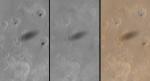
Hurtling through space above the Red Planet, potato-shaped Phobos completes an orbit of Mars in less than eight hours. In fact, since its orbital period is shorter than the planet's rotation period, Mars-based...
 The Shadow of Phobos
17.09.2005
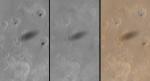
(xxxedit and linkxxx) Hurtling through space above the Red Planet, potato-shaped Phobos completes an orbit of Mars in less than eight hours. In fact, since its orbital period is shorter than the planet...
 Martian Analemma
26.06.2003
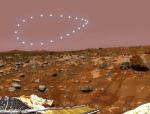
On planet Earth, an analemma is the figure-8 loop you get when you mark the position of the Sun at the same time each day throughout the year. But similarly marking the position...
 Planets and Fire by Moonlight
9.07.2008
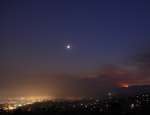
On July 5th, wandering planets, bright stars, and a young crescent Moon graced western skies after sunset. Arrayed along the solar system's ecliptic plane, the three celestial beacons forming this skyscape's eye-catching line-up with the Moon are Saturn (upper left), then Mars, and finally Regulus, alpha star of the constellation Leo.
 Planets on the Wing
6.01.2018
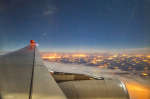
Lately, bright Jupiter and fainter Mars have been easy to spot for early morning skygazers. Before dawn on January 7 the two naked-eye planets will reach a close conjunction near the horizon, only 1/4 degree apart in predawn eastern skies. That apparent separation corresponds to about half the angular diameter of a Full Moon.
 Planets in the West
18.04.2002
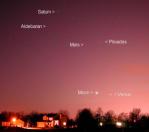
Have you seen any bright planets lately? Chances are if you've been outside under clear skies just after sunset, then you have. Now shining in the west as bright "stars" in the night sky, are all five planets of the solar system known to ancient astronomers - Mercury, Venus, Mars, Saturn, and Jupiter.
|
January February March April May June July August September October |
|||||||||||||||||||||||||||||||||||||||||||||||||