
|
You entered: Ring Nebula
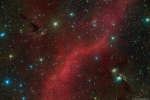 North of Orion s Belt
5.11.2020
Bright stars, interstellar clouds of dust and glowing nebulae fill this cosmic scene, a skyscape just north of Orion's belt. Close to the plane of our Milky Way Galaxy, the wide field view spans just under 5 degrees or about 10 full moons on the sky.
 NGC 7293: The Helix Nebula
24.10.2024
A mere seven hundred light years from Earth toward the constellation Aquarius, a star is dying. The once sun-like star's last few thousand years have produced the Helix Nebula. Also known...
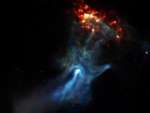 A Pulsar s Hand
1.05.2010
As far as pulsars go, PSR B1509-58 appears young. Light from the supernova explosion that gave birth to it would have first reached Earth some 1,700 years ago. The magnetized, 20 kilometer-diameter neutron star spins 7 times per second, a cosmic dynamo that powers a wind of charged particles.
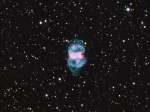 M76 Above and Below
21.11.2008
Also known by the popular name the "Little Dumbbell Nebula", M76 is one of the fainter objects listed in Charles Messier's 18th century Catalog of Nebulae and Star Clusters. Like its better-known namesake M27 (the Dumbbell Nebula), M76 is recognized as a planetary nebula - a gaseous shroud cast off by a dying sunlike star.
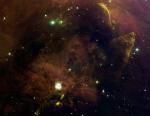 A Panorama of Oddities in Orion A
13.03.2000
New stars, fast jets, and shocked gas clouds all occupy Orion A, a giant molecular cloud just south of the Orion Nebula. The bright object visible below and slightly left of center of this recently released picture is the reflection nebula NGC 1999.
 APOD: 2024 February 12 Б HFG1 & Abell 6: Planetary Nebulae
12.02.2024
Planetary nebulae like Heckathorn-Fesen-Gull 1 (HFG1) and Abell 6 in the constellation Cassiopeia are remnants from the last phase of a medium sized star like our Sun. In spite of their shapes, planetary nebulae have nothing in common with actual planets.
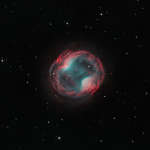 APOD: 2026 May 27 Б PK 164 +31.1: The Headphone Nebula
27.05.2026
What is a pair of headphones doing in the sky? TodayБs image features the Headphone Nebula, also known as PK 164 +31.1 or Jones-Emberson 1. This planetary nebula, the remnant of a dying Sun-like star, faintly occupies an angular region of the Lynx constellation about 1/5 th the diameter of the full moon.
 The Medusa Nebula
22.11.2024
Braided and serpentine filaments of glowing gas suggest this nebula's popular name, The Medusa Nebula. Also known as Abell 21, this Medusa is an old planetary nebula some 1,500 light-years away in the constellation Gemini. Like its mythological namesake, the nebula is associated with a dramatic transformation.
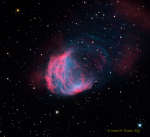 The Medusa Nebula
26.03.2021
Braided and serpentine filaments of glowing gas suggest this nebula's popular name, The Medusa Nebula. Also known as Abell 21, this Medusa is an old planetary nebula some 1,500 light-years away in the constellation Gemini. Like its mythological namesake, the nebula is associated with a dramatic transformation.
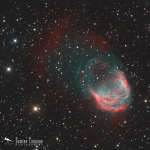 The Medusa Nebula
25.03.2022
Braided and serpentine filaments of glowing gas suggest this nebula's popular name, The Medusa Nebula. Also known as Abell 21, this Medusa is an old planetary nebula some 1,500 light-years away in the constellation Gemini. Like its mythological namesake, the nebula is associated with a dramatic transformation.
|
January February March April May June July August September October |
|||||||||||||||||||||||||||||||||||||||||||||||||