
|
You entered: composite image
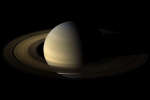 Saturn at Equinox
30.09.2009
How would Saturn look if its ring plane pointed right at the Sun? Before last month, nobody knew. Every 15 years, as seen from Earth, Saturn's rings point toward the Earth and appear to disappear.
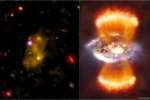 Lyman Alpha Blob
2.07.2009
Dubbed a Lyman-alpha blob, an enormous cloud of hydrogen gas spans several hundred thousand light-years in this remarkable image (left), a composite of x-ray, optical, and infrared data from space and ground based observatories.
 Star Streams of NGC 4216
27.11.2010
Some 40 million light-years distant, edge-on spiral galaxy NGC 4216 is nearly 100,000 light-years across, about the size of our own Milky Way. Found in the dense Virgo Galaxy Cluster, NGC 4216 is centered in this deep telescopic portrait flanked by fellow Virgo cluster members NGC 4206 (right) and NGC 4222.
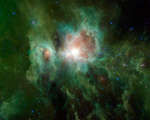 Infrared Orion from WISE
13.02.2013
The Great Nebula in Orion is a intriguing place. Visible to the unaided eye, it appears as a small fuzzy patch in the constellation of Orion. But this image, an illusory-color composite of four...
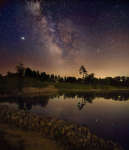 The Milky Way Over Ontario
29.07.2008
Sometimes, after your eyes adapt to the dark, a spectacular sky appears. Such was the case earlier this month over Ontario, Canada, when part of a spectacular sky also became visible in a reflection off a lake.
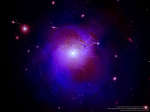 Unexpected X Rays from Perseus Galaxy Cluster
2.01.2018
Why does the Perseus galaxy cluster shine so strangely in one specific color of X-rays? No one is sure, but a much-debated hypothesis holds that these X-rays are a clue to the long-sought identity of dark matter.
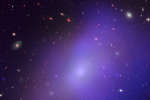 Elliptical Galaxy NGC 1132
13.02.2008
NGC 1132 is one smooth galaxy -- but how did it form? As an elliptical galaxy, NGC 1132 has little dust and gas, and few stars have formed in it recently. Although many elliptical galaxies are in clusters of galaxies, NGC 1132 appears as a large, isolated galaxy toward the constellation of the River (Eridanus).
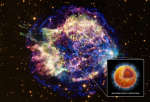 Cooling Neutron Star
5.03.2011
Supernova remnant Cassiopeia A (Cass A) is a comfortable 11,000 light-years away. Light from the Cass A supernova, the death explosion of a massive star, first reached Earth just 330 years ago.
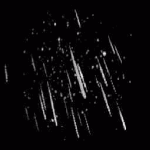 The Perseid Meteor Shower
9.08.1996
From a radiant point in the constellation of Perseus, Comet Swift-Tuttle presents -- The Perseid Meteor Shower -- coming to your night sky this weekend! A bookish E. C. Herrick of New Haven, Connecticut correctly suspected in 1837 that this meteor shower was an annual event.
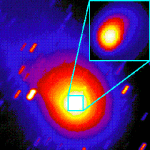 Periodic Comet Swift-Tuttle
19.02.1996
Comet Swift-Tuttle, shown above in false color, is the largest object known to make repeated passes near the Earth. It is also one of the oldest known periodic comets with sightings spanning two millennia.
|
January February March April May June July August |
||||||||||||||||||||||||||||||||||||||||||||||||||||||||