
|
You entered: surface
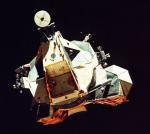 Apollo 17 s Moonship
5.01.2002
Awkward and angular looking, Apollo 17's lunar module Challenger was designed for flight in the vacuum of space. This sharp picture from the command module America, shows Challenger's ascent stage in lunar orbit.
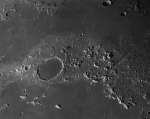 Plato and the Lunar Alps
3.12.2014
The dark-floored, 95 kilometer wide crater Plato and sunlit peaks of the lunar Alps (Montes Alpes) are highlighted in this sharp digital snapshot of the Moon's surface. While the Alps of planet Earth...
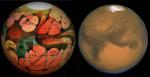 Mars Then and Now
12.11.2003
Does Mars have canals? A hot debate topic of the late 1800s, several prominent astronomers including Percival Lowell not only claimed to see an extensive system of long straight canals on Mars, but used them to indicate that intelligent life exists there.
 Charon Flyover from New Horizons
14.08.2017
What if you could fly over Pluto's moon Charon -- what might you see? The New Horizons spacecraft did just this in 2015 July as it zipped past Pluto and Charon with cameras blazing.
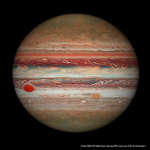 Hubbles Jupiter and the Shrinking Great Red Spot
25.04.2018
What will become of Jupiter's Great Red Spot? Gas giant Jupiter is the solar system's largest world with about 320 times the mass of planet Earth. Jupiter is home to one of the largest and longest lasting storm systems known, the Great Red Spot (GRS), visible to the left.
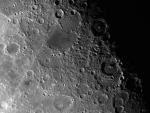 Impact Moon
26.03.1999
The Moon's surface is covered with craters, scars of frequent impacts during the early history of the solar system. Now, recent results from the Lunar Prospector spacecraft support the idea that the Moon itself formed from the debris of a giant impact of a mars-sized planetary body with the
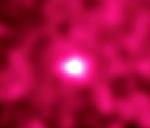 Gamma Ray Moon
27.05.2006
If you could see gamma rays - photons with a million or more times the energy of visible light - the Moon would appear brighter than the Sun! The startling notion is demonstrated by this image...
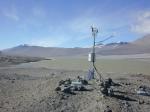 The Lost World of Lake Vida
4.04.2004
A lake hidden beneath 19 meters of ice and gravel has been found near the bottom of the world that might contain an ecosystem completely separate from our own. In a modern version...
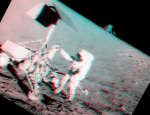 Apollo 12 and Surveyor 3 Stereo View
23.05.2009
Put on your red/blue glasses and gaze into this dramatic stereo view from the surface of the Moon. The 3D scene features Apollo 12 astronaut Pete Conrad visiting the Surveyor 3 spacecraft in November of 1969. The image was carefully created from two separate pictures (AS12-48-7133, AS12-48-7134) taken on the lunar surface.
 The Holographic Principle
23.04.2017
Is this picture worth a thousand words? According to the Holographic Principle, the most information you can get from this image is about 3 x 10 65 bits for a normal sized computer monitor.
|
January February March April May June July August September October |
|||||||||||||||||||||||||||||||||||||||||||||||||