
|
You entered: Crab Nebula
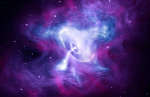 The Crab from Space
17.03.2018
The Crab Nebula is cataloged as M1, the first object on Charles Messier's famous list of things which are not comets. In fact, the Crab is now known to be a supernova remnant, expanding debris from the death explosion of a massive star.
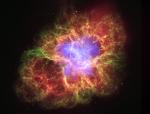 Composite Crab
26.10.2006
The Crab Nebula is cataloged as M1, the first object on Charles Messier's famous list of things which are not comets. In fact, the Crab is now known to be a supernova remnant, expanding debris from the death explosion of a massive star.
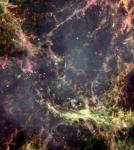 In the Heart of the Crab
5.06.2000
The supernova explosion that formed the Crab Nebula was first seen on the year 1054. Last week, astronomers released a new image of the still-evolving center of the explosion. The above representative-color photograph...
 The Crab that Played with the Planet
10.01.2003
Wandering through the constellation Taurus, Saturn made its closest approach to planet Earth last month, tilting its lovely rings toward appreciative skygazers while rising high in midnight skies. On January 4th and 5th, Saturn...
 Visual Effects: Wonders of the Universe
18.04.2011
What visual effects are depicted in this video? The effects were created by BDH for the BBC television show Wonders of the Universe, but are unlabeled on the above version posted to Vimeo. Even...
 Ultra Fast Pulsar
11.02.1998
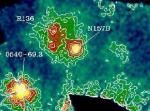
Pulsars are rotating neutron stars, born in the violent crucibles of supernova explosions. Like cosmic lighthouses, beams of radiation from surface hotspots sweep past our viewpoint creating pulses which reveal the rotation rates of these incredibly dense stellar corpses. The most famous pulsar of all is found in the nearby supernova remnant, the Crab Nebula.
 Sharpless 249 and the Jellyfish Nebula
23.03.2018
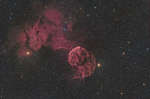
Normally faint and elusive, the Jellyfish Nebula is caught in this alluring telescopic image. Centered in the scene it's anchored right and left by two bright stars, Mu and Eta Geminorum, at the foot of the celestial twin. The Jellyfish Nebula is the brighter arcing ridge of emission with dangling tentacles.
 Sharpless 249 and the Jellyfish Nebula
27.02.2026
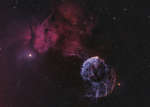
Normally faint and elusive, the Jellyfish Nebula is caught in this alluring telescopic field of view. Floating in the interstellar sea, the nebula is anchored right and left by two bright stars, Mu and Eta Geminorum, at the foot of the celestial twins.
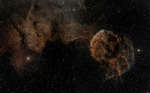 Sharpless 249 and the Jellyfish Nebula
2.12.2014
Normally faint and elusive, the Jellyfish Nebula is caught in this alluring telescopic mosaic. The scene is anchored right and left by two bright stars, Mu and Eta Geminorum, at the foot of the celestial twin while the Jellyfish Nebula is the brighter arcing ridge of emission with dangling tentacles below and right of center.
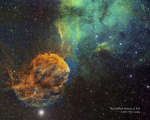 Sharpless 249 and the Jellyfish Nebula
7.01.2017
Normally faint and elusive, the Jellyfish Nebula is caught in this alluring telescopic mosaic. The scene is anchored below by bright star Eta Geminorum, at the foot of the celestial twin, while the Jellyfish Nebula is the brighter arcing ridge of emission with tentacles dangling below and left of center.
|
January February March April May June July August September October |
|||||||||||||||||||||||||||||||||||||||||||||||||