
|
You entered: Mars Global Surveyor
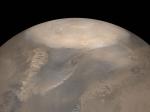 Spring Dust Storms at the North Pole of Mars
24.12.2002
Spring reached the north pole of Mars in May, and brought with it the usual dust storms. As the north polar cap begins to thaw, a temperature difference occurs between the cold frost region and recently thawed surface, resulting in swirling winds between the adjacent regions.
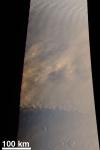 A Martian Dust Storm Approaches
9.08.1999
Batten down the hatches, here comes another Martian dust storm. The thin soil on Mars can be picked up by high winds to create dust storms that sweep down plains and can sometimes envelop most of the planet.
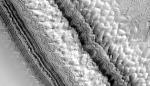 Layers of the Martian South Polar Cap
25.04.2000
The South Pole of Mars is stranger than was previously thought. Pictured above are unexpectedly complex layers photographed recently by the Mars Global Surveyor spacecraft currently orbiting Mars. The layers probably include carbon dioxide ice, water ice, rock and dust.
 A Mars Panorama from the Spirit Rover
14.01.2004
If you could stand on Mars -- what would you see? Scrolling right will reveal a full color 360-degree panoramic view from NASA's Spirit Rover that landed on Mars just 10 days ago. The image is a digital mosaic from the panoramic camera that shows the view in every direction.
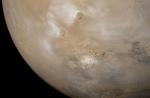 The Fogs of Mars
2.06.2003
Fogs of clouds and dust covered parts of southern Mars during last Martian winter. Giant volcanoes, such as Ascraeus Mons, the central circular feature near the top of the image, were surrounded by large water clouds. Slightly southwest, Pavonis Mons and Arisa Mons also peeked above their water clouds.
 Layered Hills in Arabia Terra on Mars
15.08.2010
Why are some hills on Mars so layered? The answer is still under investigation. Clearly, dark windblown sand surrounds outcropping of light sedimentary rock across the floor of crater Arabia Terra. The light rock clearly appears structured into many layers, the lowest of which is likely very old.
 Springtime on Mars
22.04.2003
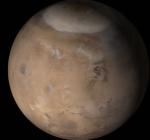
Vast canyons, towering volcanoes, sprawling fields of ice, deep craters, and high clouds can all be seen in this image of the Solar System's fourth planet: Mars. The orbiting robot Mars Global Surveyor spacecraft took the above mosaic of images as springtime dawned in Northern Mars in 2002 May.
 Haunting Mars
31.10.1997
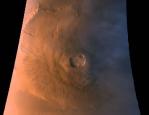
This Halloween, the news about Mars is good news - Mars Global Surveyor will resume aerobraking into a mapping orbit around the haunting red planet. Wide angle cameras onboard the spacecraft recently recorded this shadowy image of Olympus Mons, the Solar System's largest volcano, from an altitude of over 100 miles.
 Four Faces of Mars
5.07.1999
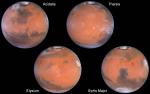
As Mars rotates, most of its surface becomes visible. During Earth's recent pass between Mars and the Sun, the Hubble Space Telescope was able to capture the most detailed time-lapse pictures ever from the Earth. Dark and light sand and gravel create an unusual blotted appearance for the red planet.
 Olympus Mons on Mars: The Largest Volcano
15.09.1997
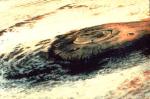
The largest volcano in the Solar System is on Mars. Olympus Mons rises 24 kilometers high and measures 550 km across. By comparison, Earth's largest volcano, Mauna Loa in Hawaii, rises 9 km high and measures 120 km across.
|
January February March April May June July August September October |
|||||||||||||||||||||||||||||||||||||||||||||||||