
|
You entered: Perseus cluster
 Star Cluster Dreams
13.04.2006
Located some 7,000 light-years away toward the constellation Perseus, this pair of open or galactic star clusters really is visible to the unaided eye and was cataloged in 130 BC by Greek astronomer Hipparchus.
 Constellation Construction
20.07.2006
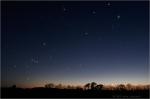
This lovely twilight scene, recorded last April, finds a young crescent Moon low in the west at sunset. Above it, stars shine in the darkening sky but they too are soon to drop below the western horizon.
 Comet McNaught Passes NGC 1245
17.06.2010
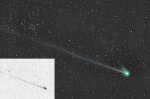
Of the many comets named for discoverer Robert McNaught, the one cataloged as C/2009 R1 is gracing dawn skies for northern hemisphere observers this month. Seen here on June 13th from southern New Mexico, this Comet McNaught's long ion tail sweeps across the telescopic field of view (a negative image is inset).
 NGC 869 and NGC 884: A Double Open Cluster
2.12.2003
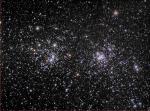
Most star clusters are singularly impressive. Open clusters NGC 869 and NGC 884, however, are doubly impressive. Also known as "h and chi Persei", this unusual double cluster, shown above, is bright enough to be seen from a dark location without even binoculars.
 Heart and Soul and Double Cluster
24.09.2016
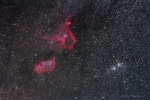
This rich starfield spans almost 10 degrees across the sky toward the northern constellations Cassiopeia and Perseus. On the left, heart-shaped cosmic cloud IC 1805 and IC 1848 are popularly known as the Heart and Soul nebulae.
 Perseid Storm
21.08.2010
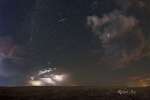
Storms on the distant horizon and comet dust raining through the heavens above are combined in this alluring nightscape. The scene was recorded in the early hours of August 13 from the Keota Star Party site on the Pawnee National Grasslands of northeastern Colorado, USA.
 NGC 869 and NGC 884: A Double Open Cluster
11.10.2005
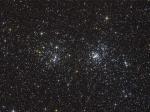
Most star clusters are singularly impressive. Open clusters NGC 869 and NGC 884, however, are doubly impressive. Also known as "h and chi Persei", this unusual double cluster, shown above, is bright enough to be seen from a dark location without even binoculars.
 NGC 869 & NGC 884: A Double Open Cluster
29.01.1997
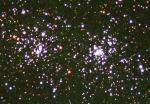
Most star clusters are singularly impressive. But open clusters NGC 869 and NGC 884 are doubly impressive. Also known as "h and chi Persei", this rare double cluster, shown above, is bright enough to be seen from a dark location without even binoculars.
 Comet Hartley Passes a Double Star Cluster
26.10.2010
Most star clusters are singularly impressive. Open clusters NGC 869 and NGC 884, however, are doubly impressive. Also known as "h and chi Persei", this unusual double cluster, shown above, is bright enough to be seen from a dark location without even binoculars.
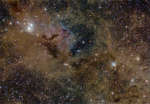 Stardust in Perseus
10.10.2015
This cosmic expanse of dust, gas, and stars covers some 6 degrees on the sky in the heroic constellation Perseus. At upper left in the gorgeous skyscape is the intriguing young star cluster IC 348 and neighboring Flying Ghost Nebula.
|
January February March April May June July August September October |
|||||||||||||||||||||||||||||||||||||||||||||||||