
|
You entered: Vela
 APOD: 2025 July 3 Б Nova V462 Lupi Now Visible
3.07.2025
If you know where to look, you can see a thermonuclear explosion from a white dwarf star. Possibly two. Such explosions are known as novas and the detonations are currently faintly visible with the unaided eye in Earth's southern hemisphere -- but are more easily seen with binoculars.
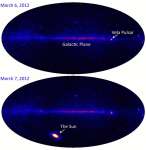 Solar Flare in the Gamma ray Sky
15.03.2012
What shines in the gamma-ray sky? The answer is usually the most exotic and energetic of astrophysical environments, like active galaxies powered by supermassive black holes, or incredibly dense pulsars, the spinning remnants of exploded stars.
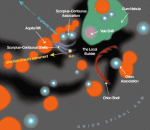 The Local Bubble and the Galactic Neighborhood
12.04.2000
What surrounds the Sun in this neck of the Milky Way Galaxy? Our current best guess is depicted in the above map of the surrounding 1500 light years constructed from various observations and deductions.
 Fermi s Gamma ray Pulsars
9.07.2009
Born in supernovae, pulsars are spinning neutron stars, collapsed stellar cores left from the death explosions of massive stars. Traditionally identified and studied by observing their regular radio pulsations, two dozen pulsars have now been detected at extreme gamma-ray energies by the Fermi Gamma-ray Space Telescope.
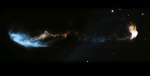 HH 47: A Young Star Jet Expands
5.09.2011
Stars remain where they are. Nebulas appear the same. Day after day. Year after year. Given the vast distances in astronomy, even fast moving objects will not appear to change their appearance in a human lifetime. Typically. A recent spectacular exception to this, however, is the supersonic jet in the star forming Herbig Haro 47.
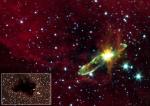 Young Star, Dark Cloud
26.12.2003
High-speed outflows of molecular gas from a young stellar object glow in infrared light, revealing themselves in this recent false-color image from the Spitzer Space Telescope. Cataloged as HH (Herbig-Haro) 46/47 the infrared source...
 APOD: 2026 March 11 Б CG 4: The Globule and the Galaxy
11.03.2026
Is this a cosmic monster ready to devour an unsuspecting galaxy? Thankfully, that is not the case. The red БmonsterБ shown in the featured image is Cometary Globule CG 4, 1,300 light-years away in the Constellation Puppis.
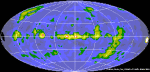 The COMPTEL Gamma-Ray Sky
29.05.1996
This premier gamma-ray view of the sky was produced by the COMPTEL instrument onboard NASA's orbiting Compton Gamma Ray Observatory. The entire sky is seen projected on a coordinate system centered on our Milky Way Galaxy with the plane of the Galaxy running across the middle of the picture.
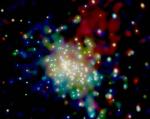 X Ray Mystery in RCW 38
27.12.2002
A mere 6,000 light-years distant and sailing through the constellation Vela, star cluster RCW 38 is full of powerful stars. It's no surprise that these stars, only a million years young with hot outer atmospheres, appear as point-like x-ray sources dotting this x-ray image from the orbiting Chandra Observatory.
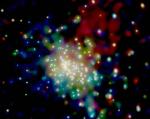 X Ray Mystery in RCW 38
8.01.2005
A mere 6,000 light-years distant and sailing through the constellation Vela, star cluster RCW 38 is full of powerful stars. It's no surprise that these stars, only a million years young with hot outer atmospheres, appear as point-like x-ray sources dotting this x-ray image from the orbiting Chandra Observatory.
|
January February March April May June July August September October |
|||||||||||||||||||||||||||||||||||||||||||||||||