
|
You entered: corona
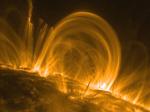 Heating Coronal Loops
14.08.2005
Why is the corona of the Sun so hot? Extending above the photosphere or visible surface of the Sun, the faint, tenuous solar corona can't be easily seen from Earth, but it is measured to be hundreds of times hotter than the photosphere itself.
 Solar Surfin
16.07.1999
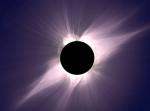
The sun's corona is a tenuous outer atmosphere composed of streams of energetic charged particles, but it is only easily seen from Earth during a total solar eclipse. For example, this 1991 image of totality from atop Mauna Kea, Hawaii forms a fleeting snapshot of the mysterious corona's beautiful, intricate structures and streams.
 Solar Eclipse and SOHO
31.03.2006
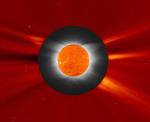
Neither rain, nor snow, nor dark of night can keep the space-based SOlar Heliospheric Observatory (SOHO) from watching the Sun. In fact, from its vantage point 150 million kilometers sunward of planet Earth, SOHO's cameras can always monitor the Sun's outer atmosphere, or corona.
 Heating Coronal Loops
28.09.2000
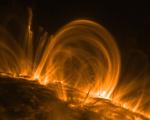
Extending above the photosphere or visible surface of the Sun, the faint, tenuous solar corona can't be easily seen from Earth, but it is measured to be hundreds of times hotter than the photosphere itself. What makes the solar corona so hot?
 The Crown of the Sun
13.12.2002
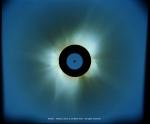
During a total solar eclipse, the Sun's extensive outer atmosphere or corona is an awesome and inspirational sight. Yet the subtle shades and shimmering features of the corona that engage the eye span a brightness range of over 10,000 to 1, making them notoriously difficult to capture in a photograph.
 Diamond Ring and Shadow Bands
24.07.2010
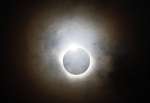
As the total phase of July 11's solar eclipse came to an end, sunlight streaming past the edge of the Moon's silhouette created the fleeting appearance of a glistening diamond ring in the sky.
 One Hundred Kilometer Terrain on Venus
7.05.2001
Even the hot and cracked surface of Venus has rolling hills. Although never actually photographed from up-close, images of the Venusian surface like that shown above have been constructed in recent years by digitally merging distant photographs with height-sensitive radar. Isolated above is a 100-kilometer wide swath inside a volcanic region known as Yavine Corona.
 Star Clouds Toward the Southern Crown
2.10.2002
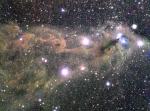
The flowing trails of dust toward Corona Australis, the constellation of the Southern Crown, are visible here because not because they glow, but because they absorb and reflect. The dust appears bluer when seen near bright stars because it preferentially reflects blue light.
 APOD: 2026 August 13 Б Total Solar Eclipse Over Spain
13.08.2026
On August 12th, 2026, the Moon totally eclipsed the Sun and cast its shadow across Siberia, Greenland, Iceland, Spain, and Portugal. TodayБs image features two total solar eclipses viewed from Zaragoza, Spain, one over the Cathedral-Basilica of Our Lady of the Pillar and the other reflecting in the Ebro River.
 Deploying Spartan
12.08.1999
Last October the Space Shuttle Discovery deployed Spartan 201, a spacecraft that monitored the corona of the Sun. Instruments on Spartan 201 were used to estimate the density of electrons emitted into the solar...
|
January February March April May June July August September October |
|||||||||||||||||||||||||||||||||||||||||||||||||