
|
You entered: dust disk
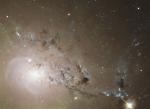 NGC 1275: A Galactic Collision
5.05.2003
In NGC 1275, one galaxy is slicing through another. The disk of the dusty spiral galaxy near the image center is cutting through a large elliptical galaxy, visible predominantly on the lower left. Galaxies...
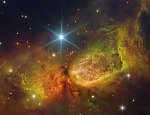 Star Forming Region S106
7.11.2011
Massive star IRS 4 is beginning to spread its wings. Born only about 100,000 years ago, material streaming out from this newborn star has formed the nebula dubbed Sharpless 2-106 Nebula (S106), pictured above.
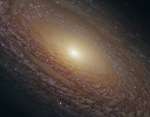 Spiral Galaxy NGC 2841 Close Up
19.02.2011
A mere 46 million light-years distant, spiral galaxy NGC 2841 can be found in the northern constellation of Ursa Major. This sharp view of the gorgeous island universe shows off a striking yellow nucleus and galactic disk.
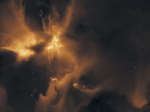 A Particle Beam Jet forms HH 24
4.02.2014
If you visit HH 24, don't go near the particle beam jet. This potential future travel advisory might be issued because the powerful jet likely contains electrons and protons moving hundreds of kilometers per second.
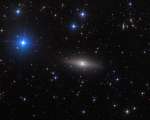 NGC 7814: The Little Sombrero in Pegasus
25.10.2013
Point your telescope toward the high flying constellation Pegasus and you can find this expanse of Milky Way stars and distant galaxies. Centered on NGC 7814, the pretty field of view would almost be covered by a full moon.
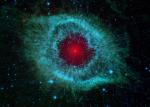 APOD: 2007 February 23- Dust and the Helix Nebula
23.02.2007
Dust makes this cosmic eye look red. The eerie Spitzer Space Telescope image shows infrared radiation from the well-studied Helix Nebula (NGC 7293) a mere 700 light-years away in the constellation Aquarius.
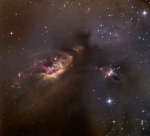 Sh2-239: Celestial Impasto
8.12.2011
The cosmic brush of star formation composed this alluring mix of dust and dark nebulae. Cataloged as Sh2-239 and LDN 1551, the region lies near the southern end of the Taurus molecular cloud complex some 450 light-years distant.
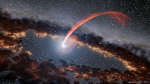 A Black Hole Disrupts a Passing Star
24.03.2020
What happens to a star that goes near a black hole? If the star directly impacts a massive black hole, then the star falls in completely -- and everything vanishes. More likely, though, the star...
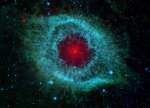 Dust and the Helix Nebula
31.12.2009
Dust makes this cosmic eye look red. The eerie Spitzer Space Telescope image shows infrared radiation from the well-studied Helix Nebula (NGC 7293) a mere 700 light-years away in the constellation Aquarius.
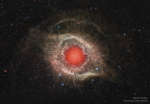 The Helix Nebula in Infrared
20.09.2016
What makes this cosmic eye look so red? Dust. The featured image from the robotic Spitzer Space Telescope shows infrared light from the well-studied Helix Nebula (NGC 7293) a mere 700 light-years away in the constellation of the Water Carrier Aquarius.
|
January February March April May June July August September |
|||||||||||||||||||||||||||||||||||||||||||||||||