
|
You entered: explorer 1
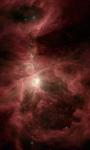 Spitzer s Orion
18.08.2006
Few cosmic vistas excite the imagination like the Orion Nebula, an immense stellar nursery some 1,500 light-years away. Also known as M42, the nebula is visible to the unaided eye, but this stunning...
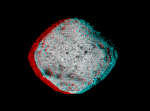 3D Bennu
13.12.2018
Put on your red/blue glasses and float next to asteroid 101955 Bennu. Shaped like a spinning top toy with boulders littering its rough surface, the tiny Solar System world is about 1 Empire State Building (less than 500 meters) across.
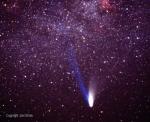 Exploring Comet Tails
13.04.2000
Comets are known for their tails. In the spring of 1997 and 1996 Comet Hale-Bopp (above) and Comet Hyakutake gave us stunning examples as they passed near the Sun. These extremely active comets were...
 Journey to the Center of the Galaxy
22.04.2000
In Jules Verne's science fiction classic A Journey to the Center of the Earth, Professor Hardwigg and his fellow explorers encounter many strange and exciting wonders. What wonders lie at the center of our Galaxy?
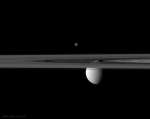 Moons Beyond Rings at Saturn
4.01.2022
What's happened to that moon of Saturn? Nothing -- Saturn's moon Rhea is just partly hidden behind Saturn's rings. In 2010, the robotic Cassini spacecraft then orbiting Saturn took this narrow-angle view looking across the Solar System's most famous rings.
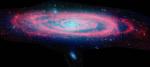 Infrared Andromeda
9.06.2006
This wide, detailed Spitzer Space Telescope view features infrared light from dust (red) and old stars (blue) in Andromeda, a massive spiral galaxy a mere 2.5 million light-years away. In fact, with over twice the diameter of our own Milky Way, Andromeda is the largest nearby galaxy.
 Infrared Andromeda
21.07.2007
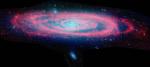
This wide, detailed Spitzer Space Telescope view features infrared light from dust (red) and old stars (blue) in Andromeda, a massive spiral galaxy a mere 2.5 million light-years away. In fact, with over twice the diameter of our own Milky Way, Andromeda is the largest nearby galaxy.
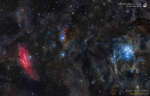 From California to the Pleiades
22.11.2013
An astronomical trip from the California Nebula to the Pleiades star cluster would cover just 12 degrees across planet Earth's night sky. That's equivalent to the angular extent of 25 Full Moons, as your telescope sweeps over the borders of the constellations Perseus and Taurus.
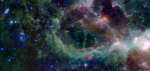 Galaxies Beyond the Heart: Maffei 1 and 2
9.03.2010
The two galaxies on the far left were unknown until 1968. Although they would have appeared as two of the brighter galaxies on the night sky, the opaque dust of the central band of our Milky Way Galaxy had obscured them from being seen in visible light.
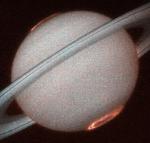 Saturnian Aurora
23.01.1999
Girdling the second largest planet in the Solar System, Saturn's Rings are one of the most spectacular sights for earthbound telescopes. This image from the orbiting Hubble Space Telescope's STIS instrument, offers a striking view of another kind of ring around Saturn - pole encircling rings of ultraviolet aurora.
|
January February March April May June July August September October |
|||||||||||||||||||||||||||||||||||||||||||||||||