
|
You entered: gravitational lens
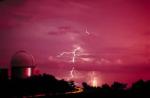 Telescope with Lightning
19.01.1999
Telescopes are not very useful during lightning storms. Nevertheless, with lightning illuminating a dark landscape, the picturesque dome of the famous Kitt Peak 2.1-meter Telescope makes for a dramatic photograph. A passing car created the red and yellow streaks visible in the foreground.
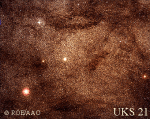 Lensing through Baade's Window
1.02.1996
What is the shape and composition of our Milky Way Galaxy? This question would be easier to answer if there wasn't so much obscuring dust! In the 1940s, however, astronomer Walter Baade identified a "window" near the center of our Galaxy where there is comparatively little opaque dust.
 Pandora s Cluster of Galaxies
9.06.2023
This deep field mosaicked image presents a stunning view of galaxy cluster Abell 2744 from the James Webb Space Telescope's NIRCam. Also dubbed Pandora's Cluster, Abell 2744 itself appears to be a ponderous merger of three different massive galaxy clusters some 3.5 billion light-years away toward the constellation Sculptor.
 Pandora's Cluster of Galaxies
8.06.2024
This deep field mosaicked image presents a stunning view of galaxy cluster Abell 2744 recorded by the James Webb Space Telescope's NIRCam. Also dubbed Pandora's Cluster, Abell 2744 itself appears to be a ponderous merger of three different massive galaxy clusters. It lies some 3.5 billion light-years away, toward the constellation Sculptor.
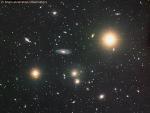 The Hydra Cluster of Galaxies
16.04.2001
The Hydra Cluster of Galaxies contains well over 100 bright galaxies - but perhaps fewer galaxies than might be expected from its mass. Clusters of galaxies are the largest gravitationally bound objects in the universe.
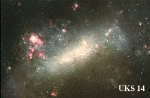 The Large Cloud Of Magellan (LMC)
24.01.1998
Ferdinand Magellan and his crew had plenty of time to study the southern sky during their famous voyage around the world. As a result, two fuzzy cloud-like objects, not visible to northern hemisphere dwellers, are now known as the Clouds of Magellan.
 When Black Holes Collide
11.04.2021
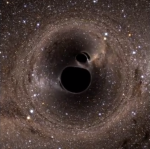
What happens when two black holes collide? This extreme scenario occurs in the centers of many merging galaxies and multiple star systems. The featured video shows a computer animation of the final stages of such a merger, while highlighting the gravitational lensing effects that would appear on a background starfield.
 Galaxy Cluster Abell S1063 and Beyond
22.07.2016
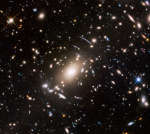
Some 4 billion light-years away, galaxies of massive Abell S1063 cluster near the center of this sharp Hubble Space Telescope snapshot. But the fainter bluish arcs are magnified images of galaxies that lie far beyond Abell S1063.
 A Bulls Eye Einstein Ring
30.03.1998
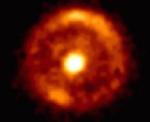
Can one galaxy hide behind another? Not in the case of B1938+666. Here the foreground galaxy acts like a huge gravitational lens, pulling the light from the background object around it, keeping it visible.
 Weighing Empty Space
8.07.2002
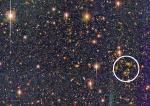
Sometimes staring into empty space is useful. Pictured above is a region of sky that was picked because it had, well, nothing: no bright stars, no bright galaxies, and no picturesque nebulas. What could not be avoided, however, were a few stars in our own Galaxy, and many distant galaxies strewn across the universe.
|
January February March April May June July August September October |
|||||||||||||||||||||||||||||||||||||||||||||||||