
|
You entered: red dwarf
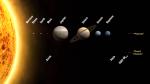 Eight Planets and New Solar System Designations
28.08.2006
How many planets are in the Solar System? This popular question now has a new formal answer according the International Astronomical Union (IAU): eight. Last week, the IAU voted on a new definition for planet and Pluto did not make the cut.
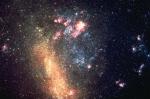 Neighboring Galaxy: The Large Magellanic Cloud
4.08.2001
The brightest galaxy visible from our own Milky Way Galaxy is the Large Magellanic Cloud (LMC). Visible predominantly from Earth's Southern Hemisphere, the LMC is the second closest galaxy, neighbor to the Small Magellanic Cloud, and one of eleven known dwarf galaxies that orbit our Milky Way Galaxy.
 Neighboring Galaxy: The Large Magellanic Cloud
22.02.2000
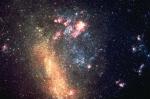
The brightest galaxy visible from our own Milky Way Galaxy is the Large Magellanic Cloud (LMC). Visible predominantly from Earth's Southern Hemisphere, the LMC is the second closest galaxy, neighbor to the Small Magellanic Cloud, and one of eleven known dwarf galaxies that orbit our Milky Way Galaxy.
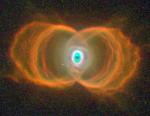 MyCn18: An Hourglass Nebula
15.06.2002
The sands of time are running out for the central star of this hourglass-shaped planetary nebula. With its nuclear fuel exhausted, this brief, spectacular, closing phase of a Sun-like star's life occurs as its outer layers are ejected - its core becoming a cooling, fading white dwarf.
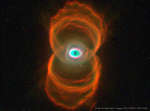 MyCn18: An Hourglass Planetary Nebula
10.05.2015
The sands of time are running out for the central star of this hourglass-shaped planetary nebula. With its nuclear fuel exhausted, this brief, spectacular, closing phase of a Sun-like star's life occurs as its outer layers are ejected - its core becoming a cooling, fading white dwarf.
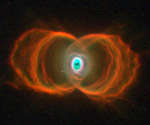 MyCn18: An Hourglass Planetary Nebula
7.08.2011
The sands of time are running out for the central star of this hourglass-shaped planetary nebula. With its nuclear fuel exhausted, this brief, spectacular, closing phase of a Sun-like star's life occurs as its outer layers are ejected - its core becoming a cooling, fading white dwarf.
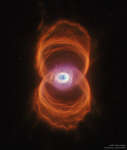 MyCn 18: The Engraved Hourglass Planetary Nebula
29.09.2019
Do you see the hourglass shape -- or does it see you? If you can picture it, the rings of MyCn 18 trace the outline of an hourglass -- although one with an unusual eye in its center. Either way, the sands of time are running out for the central star of this hourglass-shaped planetary nebula.
 APOD: 2023 October 3 Б MyCn 18: The Engraved Hourglass Planetary Nebula
3.10.2023
Do you see the hourglass shape -- or does it see you? If you can picture it, the rings of MyCn 18 trace the outline of an hourglass -- although one with an unusual eye in its center. Either way, the sands of time are running out for the central star of this hourglass-shaped planetary nebula.
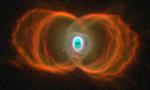 MyCn18: An Hourglass Nebula
4.06.2000
The sands of time are running out for the central star of this hourglass-shaped planetary nebula. With its nuclear fuel exhausted, this brief, spectacular, closing phase of a Sun-like star's life occurs as its outer layers are ejected - its core becoming a cooling, fading White Dwarf.
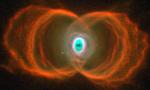 MyCn18: An Hourglass Nebula
14.09.1997
The sands of time are running out for the central star of this hourglass-shaped planetary nebula. With its nuclear fuel exhausted, this brief, spectacular, closing phase of a Sun-like star's life occurs as its outer layers are ejected - its core becoming a cooling, fading white dwarf.
|
January February March April May June July August September |
|||||||||||||||||||||||||||||||||||||||||||||||||