
|
You entered: satellite
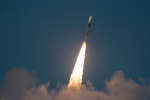 Hitomi Launches
17.02.2016
On February 17 at 5:45pm JST this H-IIA rocket blasted skyward from JAXA's Tanegashima Space Center located off the southern coast of Japan, planet Earth. Onboard was the ASTRO-H X-ray astronomy satellite, now in orbit.
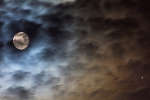 Moons Near Jupiter
22.05.2019
On May 20, a nearly Full Moon and Jupiter shared this telephoto field of view. Captured when a passing cloud bank dimmed the moonlight, the single exposure reveals the familiar face of our fair planet's own large natural satellite, along with bright Jupiter (lower right) and some of its Galilean moons.
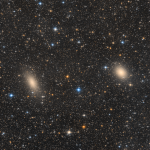 NGC 147 and NGC 185
12.02.2026
Dwarf galaxies NGC 147 (left) and NGC 185 stand side by side in this deep telescopic portrait. The two are not-often-imaged satellite galaxies of M31, the great spiral Andromeda Galaxy, some 2.5 million light-years away.
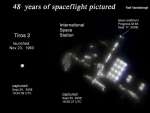 48 Years of Space Flight
16.10.2008
This year, NASA celebrated its 50th anniversary. Inspired to make his own contribution, astronomer Ralf Vandebergh set out to record images of some historic spacecraft in Earth orbit -- captured with his own modest equipment and a hand-guided, 10-inch, Newtonian reflecting telescope. One result is this intriguing composite effectively spanning 48 years of space flight!
 A Powerful Solar Flare
28.10.2003
Yesterday, our Sun produced one of the most powerful solar flares in recorded history. Seen across the electromagnetic spectrum, the Sun briefly became over 100 times brighter in X-rays than normal. Over the next few days, as energetic particles emitted from these regions strike the Earth, satellite communications might be affected and auroras might develop.
 Gamma Ray Burst: A Milestone Explosion
2.07.2000
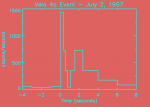
Gamma-Ray Bursts (GRBs) were discovered by accident. Thirty three years ago today, satellites first recorded a GRB. The data plotted here show that the count rate of the satellite gamma-ray instrument abruptly jumped indicating a sudden flash of gamma-rays.
 Sun 360: STEREO Captures Views of the Entire Sun
6.02.2011
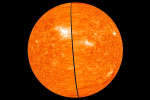
For the first time, the entire Sun is being imaged all at once. This has become possible because the two STEREO satellites orbiting and monitoring the Sun are now on opposite sides of the Sun.
 Bright Venus
7.03.2001
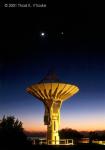
Have you seen a bright evening star in the western sky lately? That's no star, that's planet Venus the second "rock" from the Sun. Blazing at -4.6 magnitude, Venus, after the Sun and Moon, is the third brightest celestial body in planet Earth's sky.
 GOES 16: Moon over Planet Earth
25.01.2017
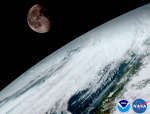
Launched last November 19 from Cape Canaveral Air Force Station, the satellite now known as GOES-16 can now observe planet Earth from a geostationary orbit 22,300 miles above the equator. Its Advanced Baseline Imager captured this contrasting view of Earth and a gibbous Moon on January 15.
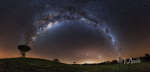 Three Galaxies over New Zealand
11.06.2014
No, radio dishes cannot broadcast galaxies. Although they can detect them, the above image features a photogenic superposition during a dark night in New Zealand about two weeks ago. As pictured above, the central part of our Milky Way Galaxy is seen rising to the east on the image left and arching high overhead.
|
January February March April May June July August |
||||||||||||||||||||||||||||||||||||||||||||||||||||||||