
|
You entered: surface
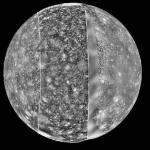 Callisto Full Face
9.12.1996
Callisto's surface shows its age. While probably formed at the same time as Io, the difference between the surfaces of these two moons of Jupiter could hardly be greater. Io's surface is young, shows practically no impact craters, and is continually being repaved by the lava exploding from its many large volcanoes.
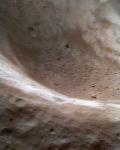 The Regolith of Asteroid Eros
29.08.2000
From fifty kilometers above asteroid Eros, the surface inside one of its largest craters appears covered with an unusual substance: regolith. The thickness and composition of the surface dust that is regolith remains a topic of much research.
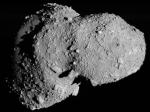 The Missing Craters of Asteroid Itokawa
21.11.2005
Where are the craters on asteroid Itokawa? No one knows. The Japanese robot probe Hayabusa recently approached the Earth-crossing asteroid and is returning pictures showing a surface unlike any other Solar System body yet photographed -- a surface possibly devoid of craters.
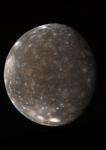 Oceans Under Jupiters Callisto
31.07.2001
Why does Jupiter's moon Callisto alter the magnetic field of Jupiter in its vicinity? Callisto itself does not have a strong magnetic field. One possible answer is that Callisto harbors sub-surface oceans of electrically conducting salt-water. This hypothesis was bolstered recently by a new analysis of how Callisto creates and dissipates heat.
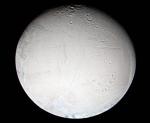 Ski Enceladus
24.02.2005
Small, icy, inner moon of Saturn, Enceladus is only about 500 kilometers in diameter. But the distant world does reflect over 90 percent of the sunlight it receives, giving its surface about the same reflectivity as fresh snow.
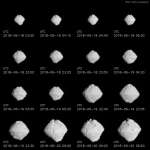 Hayabusa2 Approaches Asteroid Ryugu
25.06.2018
It looks like a big space diamond -- but with craters. It's 162173 Ryugu (Dragon's Castle), and Japan's robotic Hayabusa2 mission is now arriving at this near-Earth asteroid. Ambitious Hayabusa2 is carrying...
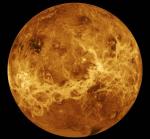 Venus Unveiled
30.03.2002
The surface of Venus is perpetually covered by a veil of thick clouds and remains hidden from even the powerful telescopic eyes of earth-bound astronomers. But in the early 1990s, using imaging radar...
 Rima Hyginus
22.02.2025
Rima Hyginus is a spectacular fissure, some 220 kilometers long, found near the center of the lunar near side. Easy to spot in telescopic views of the Moon, it stretches top left to bottom right across this lunar closeup. The image was made with exaggerated colors that reflect the mineral composition of the lunar soil.
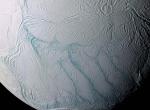 Enceladus and the Search for Water
10.03.2006
Based on data from Cassini spacecraft instruments, researchers are now arguing that liquid water reservoirs exist only tens of meters below the surface of Saturn's small (500 kilometer diameter) but active moon Enceladus. The exciting new results center around towering jets and plumes of material erupting from the moon's surface.
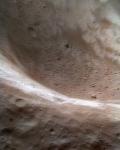 The Regolith of Asteroid Eros
3.03.2002
From fifty kilometers above asteroid Eros, the surface inside one of its largest craters appears covered with an unusual substance: regolith. The thickness and composition of the surface dust that is regolith remains a topic of much research.
|
January February March April May June July August September October |
|||||||||||||||||||||||||||||||||||||||||||||||||