
|
You entered: variable
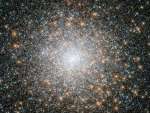 Globular Cluster M15 from Hubble
19.11.2013
Stars, like bees, swarm around the center of bright globular cluster M15. This ball of over 100,000 stars is a relic from the early years of our Galaxy, and continues to orbit the Milky Way's center.
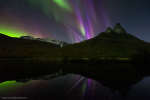 Aurora and Fireball Over Norway
5.10.2012
What's happening behind that mountain? A convergence of variable sky spectacles. One night in mid-September near TromsЬ, Norway, high red aurora could be seen shimmering through lower green aurora in a way that created a striking and somewhat unusual violet glow.
 APOD: 2025 November 26 Б Globular Cluster M15 Deep Field
26.11.2025
Stars, like bees, swarm around the center of bright globular cluster M15. The central ball of over 100,000 stars is a relic from the early years of our Galaxy, and continues to orbit the Milky Way's center.
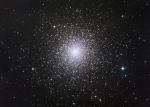 Globular Star Cluster M3
9.06.2007
This immense ball of half a million stars older than the Sun lies over 30,000 light-years away. Cataloged as M3 (and NGC 5272), it is one of about 150 globular star clusters that roam the halo of our Milky Way Galaxy.
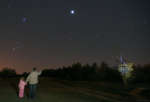 Dad Quiets Omicron Ceti
1.04.2012
The Omicron Cetians have been silenced. After alien-like monsters were reported to disturb his daughter's sleep for four nights in a row, this father took action. When last questioned, the daughter seemed to indicate that the hullabaloo might have come from a planetary system possibly sounding like "Omicron Ceti".
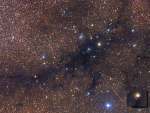 LDN 988: Dark Nebula in Cygnus
19.11.2014
Obscuring the rich starfields of northern Cygnus, dark nebula LDN 988 lies near the center of this cosmic skyscape. Composed with telescope and camera, the scene is some 2 degrees across. That corresponds to 70 light-years at the estimated 2,000 light-year distance of LDN 988.
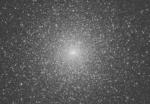 Globular Cluster M15
10.12.2001
Stars, like bees, swarm around the center of bright globular cluster M15. This ball of over 100,000 stars is a relic from the early years of our Galaxy, and continues to orbit the Milky Way's center.
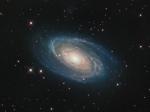 Bright Galaxy M81
7.07.2006
Big and beautiful spiral galaxy M81 lies in the northern constellation Ursa Major. One of the brightest galaxies in planet Earth's sky, M81 is also home to the second brightest supernova seen in modern times.
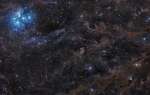 Sisters of the Dusty Sky
18.11.2010
Hurtling through a cosmic dust cloud some 400 light-years away, the lovely Pleiades or Seven Sisters star cluster is well-known for its striking blue reflection nebulae. In the dusty sky toward the constellation Taurus and the Orion Arm of our Milky Way Galaxy, this remarkable image shows the famous star cluster at the upper left.
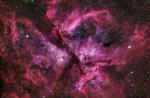 The Great Carina Nebula
27.10.2007
A jewel of the southern sky, the Great Carina Nebula, aka NGC 3372, spans over 300 light-years, one of our galaxy's largest star forming regions. Like the smaller, more northerly Orion Nebula...
|
January February March April May June July August September October |
|||||||||||||||||||||||||||||||||||||||||||||||||