
|
You entered: galaxy cluster
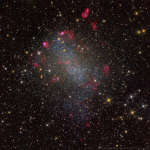 NGC 6822: Barnard s Galaxy
28.11.2020
Grand spiral galaxies often seem to get all the glory, flaunting their young, bright, blue star clusters in beautiful, symmetric spiral arms. But small galaxies form stars too, like nearby NGC 6822, also known as Barnard's Galaxy.
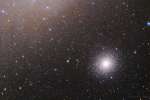 47 Tuc Near the Small Magellanic Cloud
6.12.2012
Globular star cluster 47 Tucanae is a jewel of the southern sky. Also known as NGC 104, it roams the halo of our Milky Way Galaxy along with around 200 other globular star clusters.
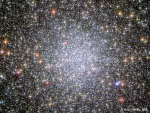 Globular Star Cluster 47 Tuc
19.05.2015
Globular star cluster 47 Tucanae is a jewel box of the southern sky. Also known as NGC 104, it roams the halo of our Milky Way Galaxy along with over 150 other globular star clusters.
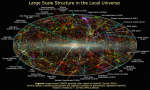 The Universe Nearby
11.12.2007
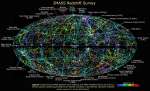
What does the universe nearby look like? This plot shows over one and a half million of the brightest stars and galaxies in the nearby universe detected by the Two Micron All Sky Survey (2MASS) in infrared light.
 The Universe Nearby
14.06.2011
What does the universe nearby look like? This plot shows nearly 50,000 galaxies in the nearby universe detected by the Two Micron All Sky Survey (2MASS) in infrared light. The resulting image is anincredible tapestry of galaxies that provides limits on how the universe formed and evolved.
 Young Suns of NGC 7129
29.08.2016
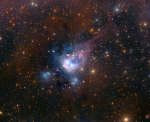
Young suns still lie within dusty NGC 7129, some 3,000 light-years away toward the royal constellation Cepheus. While these stars are at a relatively tender age, only a few million years old, it is likely that our own Sun formed in a similar stellar nursery some five billion years ago.
 Messier 106
9.04.2021
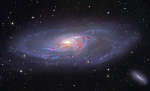
Close to the Great Bear (Ursa Major) and surrounded by the stars of the Hunting Dogs (Canes Venatici), this celestial wonder was discovered in 1781 by the metric French astronomer Pierre Mechain. Later, it was added to the catalog of his friend and colleague Charles Messier as M106.
 Facing NGC 6946
4.10.2002
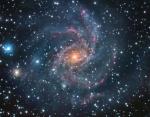
From our vantage point in the Milky Way Galaxy, we see NGC 6946 face on. The big beautiful spiral galaxy is located just 10 million light-years away, behind a veil of foreground stars in the high and far-off constellation of Cepheus.
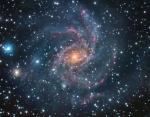 Facing NGC 6946
10.04.2004
From our vantage point in the Milky Way Galaxy, we see NGC 6946 face-on. The big beautiful spiral galaxy is located just 10 million light-years away, behind a veil of foreground stars in the high and far-off constellation of Cepheus.
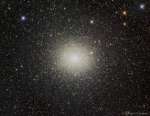 Omega Centauri: The Brightest Globular Star Cluster
27.04.2016
This huge ball of stars predates our Sun. Long before humankind evolved, before dinosaurs roamed, and even before our Earth existed, ancient globs of stars condensed and orbited a young Milky Way Galaxy. Of the 200 or so globular clusters that survive today, Omega Centauri is the largest, containing over ten million stars.
|
January February March April May June July August September October |
|||||||||||||||||||||||||||||||||||||||||||||||||