
|
You entered: planet
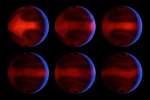 A Dangerous Summer on HD 80606b
4.02.2009
On the distant planet HD 80606b, summers might be dangerous. Hypothetic life forms floating in HD 080606b's atmosphere or lurking on one of its (presently hypothetical) moons might fear the 1,500 Kelvin summer heat, which is hot enough not only to melt lead but also nickel.
 Mars, Ceres, Vesta
10.04.2014
That bright, ruddy star you've recently noticed rising just after sunset isn't a star at all. That's Mars, the Red Planet. Mars is now near its 2014 opposition (April 8) and closest approach (April 14), looping through the constellation Virgo opposite the Sun in planet Earth's sky.
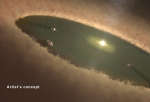 The Double Dust Disks of HD 95086
16.11.2014
What do other star systems look like? To help find out, astronomers are carrying out detailed observations of nearby stars in infrared light to see which have dust disks that might be forming planets.
 The Shadow of Ingenuity s Damaged Rotor Blade
10.02.2024
On January 18, 2024, during its 72nd flight in the thin Martian atmosphere, autonomous Mars Helicopter Ingenuity rose to an altitude of 12 meters (40 feet) and hovered for 4.5 seconds above the Red Planet. Ingenuity's 72nd landing was a rough one though.
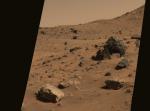 Strangers on Mars
21.07.2006
This view from the winter station of Mars Exploration Rover Spirit, looks across the rock strewn landscape of Gusev Crater. The dark boulders and distant hills are characteristic of the region...
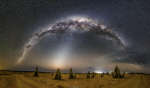 Milky Way and Zodiacal Light over Australian Pinnacles
23.10.2022
What strange world is this? Earth. In the foreground of the featured image are the Pinnacles, unusual rock spires in Nambung National Park in Western Australia. Made of ancient sea shells (limestone), how these human-sized picturesque spires formed remains a topic of research. The picturesque panorama was taken in 2017 September.
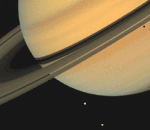 Saturn with Moons Tethys and Dione
31.05.1997
Saturn and two of its larger moons - Tethys and Dione - were photographed by the Voyager 1 spacecraft which flew by the planet in November of 1980. This picture gives an indication of Saturn's extensive ring system, which can be seen casting a shadow on the planet, as does Tethys.
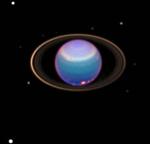 Infrared Uranus
20.10.1998
The Sun's third largest planet usually looks quite dull. Uranus typically appears as a featureless small spot in a small telescope or a featureless large orb in a large telescope. Last August, however...
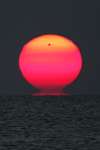 When Venus Rises with the Sun
8.06.2012
This dramatic telephoto view across the Black Sea on June 6 finds Venus rising with the Sun, the planet in silhouette against a ruddy and ragged solar disk. Of course, the reddened light...
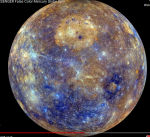 All of Mercury
28.04.2019
Only six years ago, the entire surface of planet Mercury was finally mapped. Detailed observations of the innermost planet's surprising crust began when the robotic have been ongoing since the robotic MESSENGER spacecraft first passed Mercury in 2008 and continued until its controlled crash landing in 2015.
|
January February March April May June July August September October |
|||||||||||||||||||||||||||||||||||||||||||||||||