
|
You entered: ring galaxy
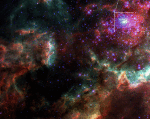 In the Center of 30 Doradus
20.02.1999
In the center of 30 Doradus lies a huge cluster of the largest, hottest, most massive stars known. The center of this cluster, known as R136, is boxed in the upper right portion of the above picture.
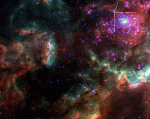 In the Center of 30 Doradus
24.05.1996
In the center of 30 Doradus lies a huge cluster of the largest, hottest, most massive stars known. The center of this cluster, known as R136, is boxed in the upper right portion of the above picture.
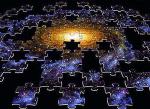 Will the Universe End in a Big Rip
2.03.2003
How will our universe end? Recent speculation now includes a pervasive growing field of mysterious repulsive energy that rips virtually everything apart. Although the universe started with a Big Bang, analysis of recent cosmological measurements allows a possibility that it will end with a Big Rip.
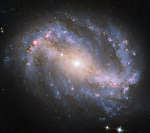 Barred Spiral Galaxy NGC 6217
27.12.2009
Many spiral galaxies have bars across their centers. Even our own Milky Way Galaxy is thought to have a modest central bar. Prominently barred spiral galaxy NGC 6217, pictured above, was captured in spectacular detail in this recently released image taken by the newly repaired Advanced Camera for Surveys on the orbiting Hubble Space Telescope.
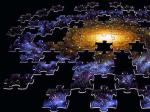 Will the Universe End in a Big Rip
21.10.2007
How will our universe end? Recent speculation now includes a pervasive growing field of mysterious repulsive phantom energy that rips virtually everything apart. Although the universe started with a Big Bang, analysis of cosmological measurements allows a possibility that it will end with a Big Rip.
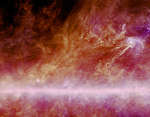 The Nearby Milky Way in Cold Dust
21.03.2010
What shapes the remarkable dust tapestry of the nearby Milky Way Galaxy? No one knows for sure. The intricate structures, shown above, were resolved in new detail recently in a wide region of the sky imaged in far infrared light by the European Space Agency's Planck satellite.
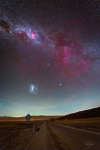 The Gum Nebula Supernova Remnant
28.11.2022
Because the Gum Nebula is the closest supernova remnant, it is actually hard to see. Spanning 40 degrees across the sky, the nebula appears so large and faint that it is easily lost in the din of a bright and complex background.
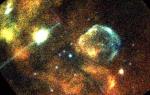 XMM-Newton First Light: X-Rays From The LMC
10.02.2000
Recently the European Space Agency released this and other spectacular "first light" pictures from its new orbiting x-ray observatory, christened XMM-Newton. A churning region of star birth and death in our small neighboring galaxy, the Large Magellanic Cloud (LMC), this field was one of several chosen to test out XMM-Newton's x-ray imaging capabilities.
 Arp 299: Black Holes in Colliding Galaxies
31.10.2016
Is only one black hole spewing high energy radiation -- or two? To help find out, astronomers trained NASA's Earth-orbiting NuSTAR and Chandra telescopes on Arp 299, the enigmatic colliding galaxies expelling the radiation.
 Canaries Sky
10.04.1999
This gorgeous view of stars, nebulae, and the Milky Way comes from the dark night sky above the lovely island of La Palma in the Canaries archipelago. The picture was made by a group...
|
January February March April May June July August September October |
|||||||||||||||||||||||||||||||||||||||||||||||||