
|
You entered: image
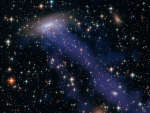 Stripping ESO 137-001
1.08.2015
Spiral galaxy ESO 137-001 hurtles through massive galaxy cluster Abell 3627 some 220 million light years away. The distant galaxy is seen in this colorful Hubble/Chandra composite image through a foreground of the Milky Way's stars toward the southern constellation Triangulum Australe.
 Perihelion Approaches
15.08.2015
This dramatic outburst from the nucleus of Comet 67P/Churyumov-Gerasimenko occured on August 12, just hours before perihelion, its closest approach to the Sun. Completing an orbit of the Sun once every 6.45 years, perihelion distance for this periodic comet is about 1.3 astronomical units (AU), still outside the orbit of planet Earth (at 1 AU).
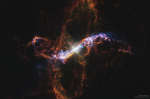 Symbiotic R Aquarii
11.07.2018
You can see it change in brightness with just binoculars over the course of a year. Variable star R Aquarii is actually an interacting binary star system, two stars that seem to have a close, symbiotic relationship.
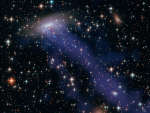 Stripping ESO 137-001
25.08.2018
Spiral galaxy ESO 137-001 hurtles through massive galaxy cluster Abell 3627 some 220 million light years away. The distant galaxy is seen in this colorful Hubble/Chandra composite image through a foreground of the Milky Way's stars toward the southern constellation Triangulum Australe.
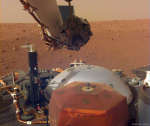 Sound and Light Captured by Mars InSight
10.12.2018
Your arm on Mars has unusual powers. For one thing it is nearly 2 meters long, has a scoop and grapple built into its hand, and has a camera built into its forearm. For another, it will soon deploy your ear -- a sensitive seismometer that will listen for distant rumblings -- onto the surface of Mars.
 Abell 2218: A Galaxy Cluster Lens
10.07.1995
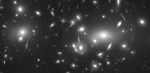
Sometimes one of the largest concentrations of mass known can act like a lens. Almost all of the bright objects in this image are galaxies in the cluster known as Abell 2218. The cluster...
 Pluto Not Yet Explored
12.02.1996
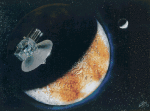
Cold, distant, Pluto is the only planet in our Solar System which has not been visited by a spacecraft from Earth. The story goes that the legend "Pluto Not Yet Explored" on a US postal stamp depicting the tiny, mysterious world inspired a JPL employee to develop plans for a Pluto flyby.
 NGC1850: Star Cluster in the LMC
20.06.1997
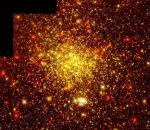
NGC1850 is a large cluster of stars located a mere 166,000 light-years from Earth in our neighboring galaxy the Large Magellanic Cloud (LMC). The colors in this beautiful Hubble Space Telescope composite image of the cluster reveal different populations of stars.
 The Magnetic Carpet Of The Sun
6.11.1997
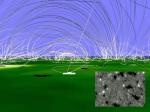
The Sun has a magnetic carpet. Its visible surface appears to be carpeted with tens of thousands of magnetic north and south poles joined by looping field lines which extend outward into the Solar Corona.
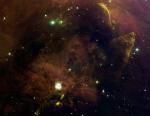 A Panorama of Oddities in Orion A
13.03.2000
New stars, fast jets, and shocked gas clouds all occupy Orion A, a giant molecular cloud just south of the Orion Nebula. The bright object visible below and slightly left of center of this recently released picture is the reflection nebula NGC 1999.
|
January February March April May June July August September |
|||||||||||||||||||||||||||||||||||||||||||||||||