
|
You entered: young stars
 NGC 1365: A Nearby Barred Spiral Galaxy
13.04.2003
Many spiral galaxies have bars across their centers. Even our own Milky Way Galaxy is thought to have a bar, but perhaps not so prominent as the one in NGC 1365, shown above. The persistence and motion of the bar imply relatively massive spiral arms.
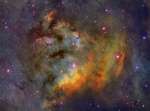 Sharpless 171
18.10.2008
Cosmic pillars of cold molecular gas and clouds of dark dust lie within Sharpless 171, a star-forming region some 3,000 light-years away in the royal constellation Cepheus. This tantalizing false-color skyscape spans about 20 light-years across the nebula's bright central region.
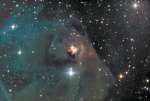 T Tauri and Hind s Variable Nebula
13.12.2007
The orange star centered in this remarkable telescopic skyview is T Tauri, protoytpe of the class of T Tauri variable stars. Nearby it is a dusty yellow cosmic cloud historically known as Hind's Variable Nebula (aka NGC 1555/1554).
 APOD: 2023 August 28 Б Star Formation in the Pacman Nebula
28.08.2023
Look through the cosmic cloud cataloged as NGC 281 and you might miss the stars of open cluster IC 1590. Formed within the nebula, that cluster's young, massive stars ultimately power the pervasive nebular glow.
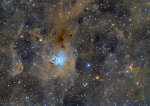 Haunting the Cepheus Flare
29.10.2021
Spooky shapes seem to haunt this dusty expanse, drifting through the night in the royal constellation Cepheus. Of course, the shapes are cosmic dust clouds visible in dimly reflected starlight. Far from your...
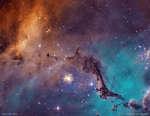 N11: Star Clouds of the LMC
12.04.2022
Massive stars, abrasive winds, mountains of dust, and energetic light sculpt one of the largest and most picturesque regions of star formation in the Local Group of Galaxies. Known as N11, the region...
 NGC 1365: A Nearby Barred Spiral Galaxy
24.06.1999
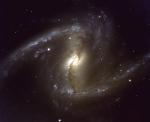
Many spiral galaxies have bars across their centers. Even our own Milky Way Galaxy is thought to have a bar, but perhaps not so prominent as the one in NGC 1365, shown above. The persistence and motion of the bar imply relatively massive spiral arms.
 Hot Stars in the Rosette Nebula
26.07.2007
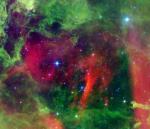
Winds and radiation from massive hot stars in the Rosette Nebula have cleared the natal gas and dust from the center of the nearby star-forming region. They also pose a danger to planet forming disks around young, cooler stars in the neighborhood.
 T Tauri and Hind s Variable Nebula
26.03.2011
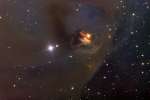
The yellowish star near center in this remarkable telescopic skyview is T Tauri, prototype of the class of T Tauri variable stars. Nearby it is a dusty yellow cosmic cloud historically known as Hind's Variable Nebula (NGC 1555).
 T Tauri and Hind s Variable Nebula
3.05.2014
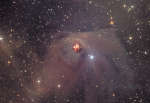
The yellowish star near center in this dusty telescopic skyview is T Tauri, prototype of the class of T Tauri variable stars. Just next door is the yellow cosmic cloud historically known as Hind's Variable Nebula (NGC 1555).
|
January February March April May June July August September October |
|||||||||||||||||||||||||||||||||||||||||||||||||