
|
You entered: Earth's moon
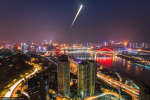 Eclipse at Moonrise
11.10.2014
As the Moon rose and the Sun set on October 8, a lunar eclipse was in progress seen from Chongqing, China. Trailing through this composite time exposure, the rising Moon began as a dark reddened disk in total eclipse near the eastern horizon.
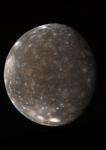 Oceans Under Jupiters Callisto
31.07.2001
Why does Jupiter's moon Callisto alter the magnetic field of Jupiter in its vicinity? Callisto itself does not have a strong magnetic field. One possible answer is that Callisto harbors sub-surface oceans of electrically conducting salt-water. This hypothesis was bolstered recently by a new analysis of how Callisto creates and dissipates heat.
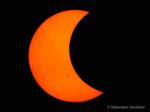 Solstice And Season's Eclipse
21.12.2000
Today the Sun reaches its southernmost point in planet Earth's sky at 13:37 UT. This celestial event is known as a solstice, marking the beginning of Summer in the Southern Hemisphere and Winter in the North.
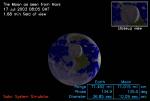 Mars Simulated View
16.07.2003
When earthdweller Patrick Vantuyne wondered what his home planet's single large moon would look like if viewed from Mars on July 17, he availed himself of the JPL Solar System Simulator. Of course...
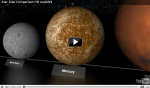 Star Size Comparisons
22.02.2011
How big is our Sun compared to other stars? In a dramatic and popular video featured on YouTube, the relative sizes of planets and stars are shown from smallest to largest. The above video starts with Earth's Moon and progresses through increasingly larger planets in our Solar System.
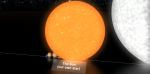 Star Size Comparisons
6.06.2013
How big is our Sun compared to other stars? In a dramatic and popular video featured on YouTube, the relative sizes of planets and stars are shown from smallest to largest. The above video starts with Earth's Moon and progresses through increasingly larger planets in our Solar System.
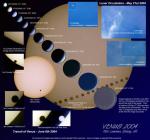 A Rare Annular Venusian Solar Eclipse
15.06.2004
An unusual type of solar eclipse occurred last week. Usually it is the Earth's Moon that eclipses the Sun. Last week, for the first time in over 100 years, the planet Venus took a turn.
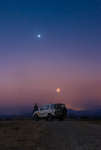 Love and War by Moonlight
16.07.2021
Venus, named for the Roman goddess of love, and Mars, the war god's namesake, come together by moonlight in this serene skyview, recorded on July 11 from Lualaba province, Democratic Republic of Congo, planet Earth.
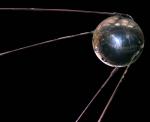 50th Anniversary of Sputnik: Traveling Companion
4.10.2007
Sputnik means "traveling companion". Despite the innocuous sounding name, the launch of planet Earth's first artificial moon, Sputnik 1, by the Soviet Union on October 4, 1957, changed the world and set in motion events which resulted in the creation of NASA and the race to the Moon.
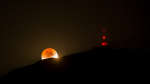 Shadowed Moon and Mountain
18.07.2019
On July 16 the Moon celebrated the 50th anniversary of the launch of Apollo 11 with a lunar eclipse visible from much of planet Earth. In this view part of the lunar disk is immersed in Earth's dark, reddened umbral shadow. Near the maximum eclipse phase, it just touches down along a mountain ridge.
|
January February March April May June July August September |
|||||||||||||||||||||||||||||||||||||||||||||||||