
|
You entered: X-ray
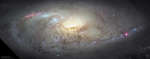 M106 Close Up
3.10.2013
Close to the Great Bear (Ursa Major) and surrounded by the stars of the Hunting Dogs (Canes Venatici), this celestial wonder was discovered in 1781 by the metric French astronomer Pierre Mechain. Later, it was added to the catalog of his friend and colleague Charles Messier as M106.
 APOD: 2025 January 29 Б Dust Shells around WR 140 from Webb
29.01.2025
What are those strange rings? Rich in dust, the rings are likely 3D shells -- but how they were created remains a topic of research. Where they were created is well known: in a binary...
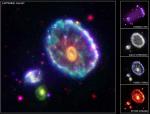 Cartwheel Of Fortune
18.01.2006
By chance, a collision of two galaxies has created a surprisingly recognizable shape on a cosmic scale - The Cartwheel Galaxy. The Cartwheel is part of a group of galaxies about 400 million light years away in the constellation Sculptor (two smaller galaxies in the group are visible below and left).
 APOD: 2024 March 25 Б Sonified: The Jellyfish Nebula Supernova Remnant
25.03.2024
What does a supernova remnant sound like? Although sound is a compression wave in matter and does not carry into empty space, interpretive sound can help listeners appreciate and understand a visual image of a supernova remnant in a new way. Recently, the Jellyfish Nebula (IC 443) has been sonified quite creatively.
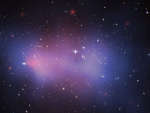 The El Gordo Massive Galaxy Cluster
22.04.2014
It is bigger than a bread box. In fact, it is much bigger than all bread boxes put together. Galaxy cluster ACT-CL J0102-4915 is one of the largest and most massive objects known. Dubbed...
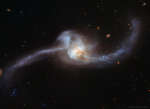 NGC 2623: Merging Galaxies from Hubble
10.01.2018
Where do stars form when galaxies collide? To help find out, astronomers imaged the nearby galaxy merger NGC 2623 in high resolution with the Hubble Space Telescope. Analysis of this and other Hubble images...
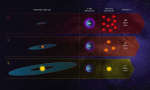 Goldilocks Zones and Stars
31.01.2020
The Goldilocks zone is the habitable zone around a star where it's not too hot and not too cold for liquid water to exist on the surface of orbiting planets. This intriguing infographic...
 M83: The Southern Pinwheel
16.01.2025
Beautiful and bright spiral galaxy M83 lies a some twelve million light-years away, near the southeastern tip of the very long constellation Hydra. Prominent spiral arms traced by dark dust lanes and blue star clusters lend this galaxy its popular name, The Southern Pinwheel.
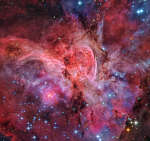 Carina Nebula Close Up
15.02.2020
A jewel of the southern sky, the Great Carina Nebula, also known as NGC 3372, spans over 300 light-years, one of our galaxy's largest star forming regions. Like the smaller, more northerly Great...
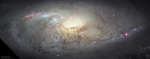 M106 Close Up
3.05.2012
Close to the Great Bear (Ursa Major) and surrounded by the stars of the Hunting Dogs (Canes Venatici), this celestial wonder was discovered in 1781 by the metric French astronomer Pierre Mechain. Later, it was added to the catalog of his friend and colleague Charles Messier as M106.
|
January February March April May June July August September October |
|||||||||||||||||||||||||||||||||||||||||||||||||